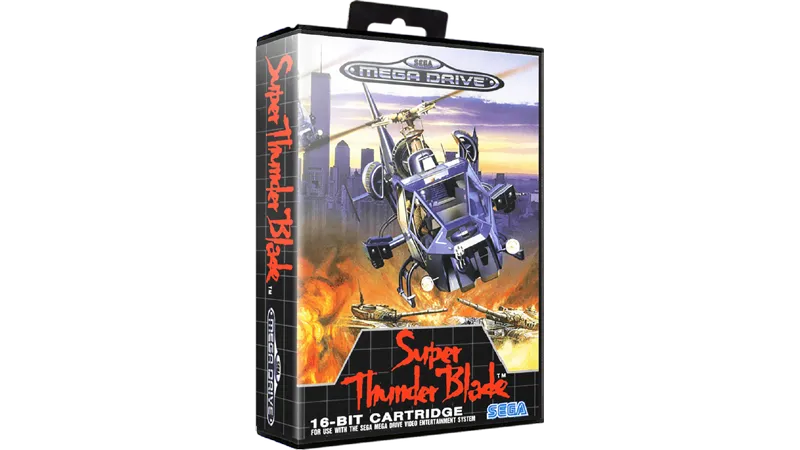
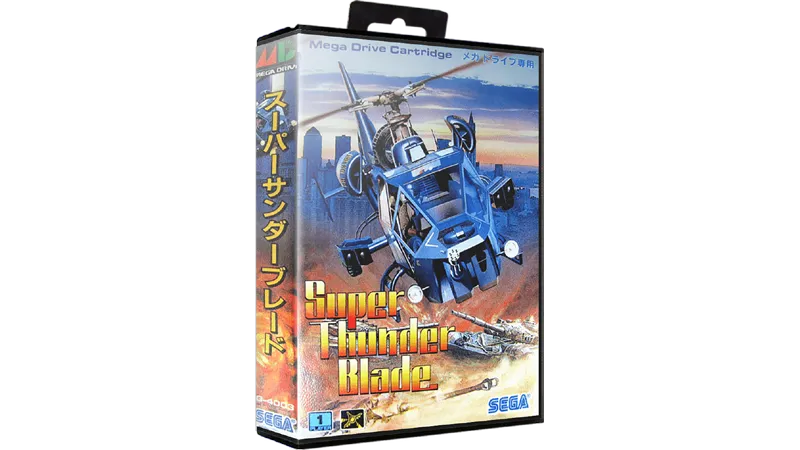



As a 1988 launch title for the Mega Drive, Super Thunder Blade carried the heavy burden of proving that Sega’s 16-bit powerhouse could replicate the intense "Super Scaler" arcade experiences in the home. Taking the role of a high-tech combat helicopter pilot, players are thrust into a series of missions that alternate between traditional top-down scrolling and a behind-the-back pseudo-3D perspective. While it visually signaled a massive leap over the Master System, it was immediately clear that this was a reimagining rather than a direct port of the arcade original, lacking many of the complex stages and environmental transitions found in the coin-op version.
The gameplay relies on a mix of rapid-fire vulcan cannons and lock-on missiles to navigate through cityscapes, caves, and oceanic military bases. The 3D segments are the main draw, utilizing the console’s ability to manipulate large sprites to simulate depth, though the choppy frame rate often compromises the sense of speed and precision. Control is notably sensitive; the helicopter moves with a twitchy momentum that makes dodging incoming fire and navigating tight tunnels frustratingly difficult. Consequently, the difficulty curve is steep, demanding rigid memorization rather than pure reflex, which can alienate players used to the smoother scaling found in later titles like Space Harrier II.
Despite its technical ambition, Super Thunder Blade feels like a relic of the console's early growing pains, offering a shallow experience that can be completed in under twenty minutes once mastered. The sound design is a highlight, featuring a driving FM-synth soundtrack that captures the high-octane energy of late-80s action cinema, but the repetitive level design and heavy sprite flickering hold it back from greatness. It remains an important piece of Sega history as a foundational release, yet it serves more as a nostalgic curiosity than a compelling shooter in the modern era.