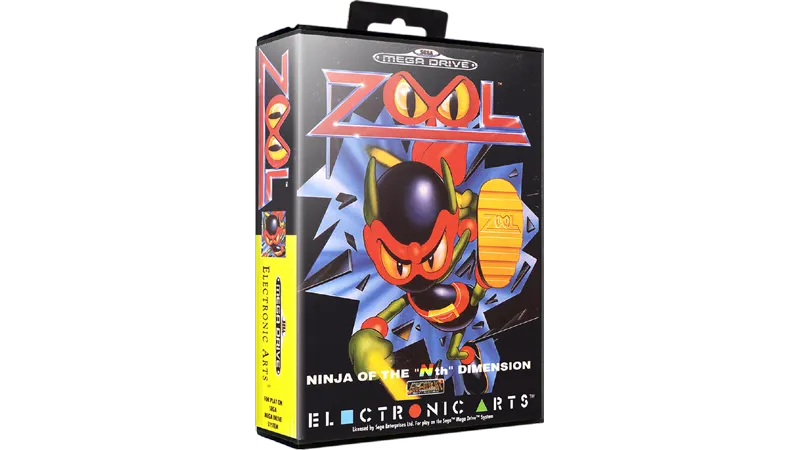

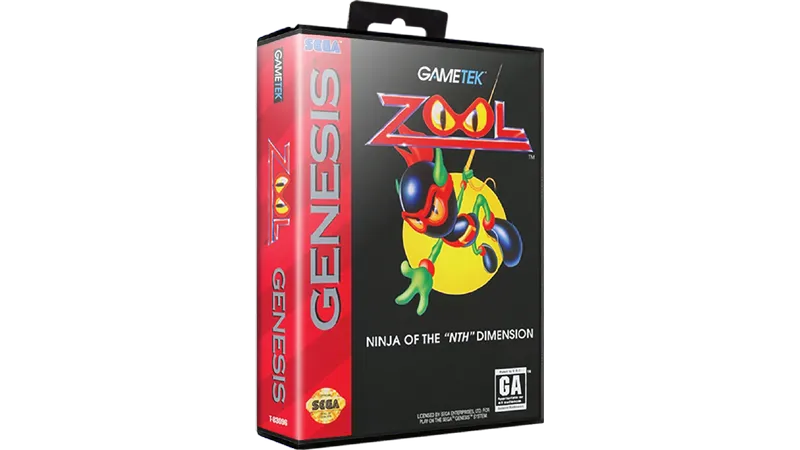


Zool burst onto the Mega Drive as the Amiga’s high-octane answer to Sonic the Hedgehog, bringing a frantic, candy-coated energy that defines the early 90s European development scene. As the "Ninja from the Nth Dimension," players are thrust into a series of vibrantly colored worlds, most famously the Sweet Zone, which is plastered with blatant Chupa Chups branding. The game leans heavily into its sense of speed, featuring a protagonist who can sprint, jump, and cling to walls with a nimble, if somewhat slippery, grace. While the visual flair and smooth scrolling were impressive for the time, the sheer density of the sprite-work often makes for a cluttered screen where enemies and hazards can be difficult to distinguish from the sugary backgrounds.
The gameplay loop centers on collecting specific items to open the exit, forcing players to explore sprawling, non-linear levels rather than just sprinting to the right. Zool’s move set is surprisingly versatile for a 16-bit platformer; he can slide, fire projectiles, and perform a spinning jump that serves as his primary attack. However, the Mega Drive port struggles slightly with the precision required for these maneuvers. The momentum-based movement feels floatier than its Amiga counterpart, and the hit detection can be notoriously unforgiving. This results in a high difficulty curve that relies more on trial-and-error memorization of enemy placements than pure twitch reflexes.
Technically, the conversion to Sega’s hardware is a mixed bag that ultimately succeeds on the strength of its presentation. The soundtrack, composed by Patrick Phelan, is a standout feature, delivering a pumping techno-pop score that perfectly complements the game’s frenetic pace. While the Mega Drive’s limited color palette can’t quite match the richness of the original Amiga AGA version, the scrolling is rock-solid and the action rarely slows down, even when the screen is filled with projectiles. It remains a polarizing title—a relic of an era where every developer was desperate to find a "Sonic-killer"—but its unique charm and aggressive speed ensure it holds a special place in the 16-bit library.