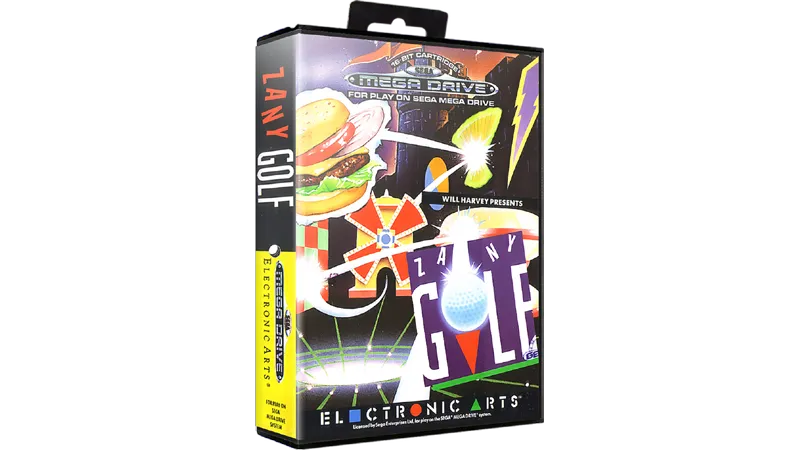



EA’s Zany Golf arrived on the Mega Drive during a transformative period for the publisher, marking an ambitious attempt to port their successful computer hits to the home console market. Originally a standout title on the Amiga and PC, this isometric miniature golf simulator swapped mouse-driven precision for D-pad navigation. The transition is mostly successful, capturing the vibrant, surrealist aesthetic of holes like the giant hamburger or the fan-blown laboratory. It serves as a reminder of a time when Electronic Arts prioritized experimental, boutique experiences over the homogenized sports sims that would later define their 16-bit legacy.
In terms of mechanics, the isometric perspective is both the game’s greatest strength and its most significant hurdle. While it allows for creative, multi-level course architecture, it frequently results in depth perception errors that lead to frustrating strokes. The game operates on an "Energy" system rather than a standard stroke count, forcing players to complete holes quickly to bank time for the later, more complex stages. This adds an arcade-like tension to the experience, though with only nine holes available in total, the game can be completed in under twenty minutes once the patterns are mastered.
While the Mega Drive’s sound chip cannot quite replicate the atmospheric score of the original computer versions, the whimsical spirit remains intact. It is a short-lived but memorable curiosity that represents the early gold rush of the 16-bit era. For collectors, it is a quintessential "Yellow Tab" EA release that prioritizes charm and personality over technical complexity.