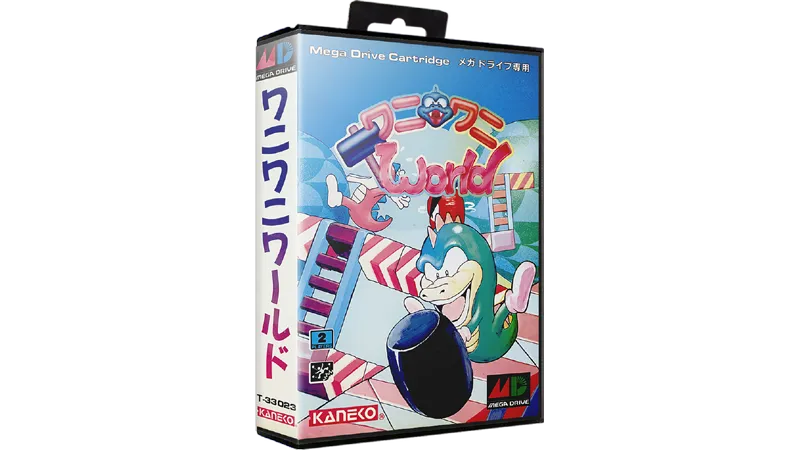

Wani Wani World is a quintessential example of the "single-screen platformer" genre that flourished in the early 90s, heavily inspired by titles like Space Panic and Don Doko Don. Developed by Kaneko, the game puts players in the scales of a hammer-wielding crocodile tasked with clearing various themed stages of quirky monsters. The central mechanic involves smashing floor tiles to create pitfalls, trapping enemies inside, and then delivering a satisfying final blow with your mallet to send them tumbling down through the levels. It is a formula that prioritizes spatial awareness and timing over raw speed, providing a rhythmic, almost hypnotic gameplay loop that feels perfectly at home on the Mega Drive hardware.
Visually, the game is a vibrant explosion of color, utilizing a bright palette that stands in stark contrast to the grittier library often associated with Sega’s 16-bit machine. The sprite work is charming and expressive, with the protagonist and enemies exhibiting a "kawaii" aesthetic that reflects its Japanese arcade roots. Each of the worlds—ranging from toy boxes to icy landscapes—is meticulously detailed, accompanied by an upbeat, bouncy FM-synth soundtrack that reinforces the lighthearted tone. While it doesn't push the console to its technical limits, the fluid animations and lack of flicker during chaotic moments demonstrate a high level of polish and optimization.
Despite its quality, Wani Wani World never saw an official Western localization, leaving it as a hidden gem for importers. This highlights the odd regional disparities of the era; for example, while the abstract puzzler Zoop was released in the UK and Europe in 1995, it never saw a Japanese release for this specific console, whereas Wani Wani World remained a Japanese exclusive. The game remains a high-water mark for the genre on the system, offering a cooperative two-player mode that elevates the experience from a simple arcade port to an essential social gaming session. It is a testament to Kaneko’s ability to take a simple concept and refine it into a pure, addictive 16-bit experience.