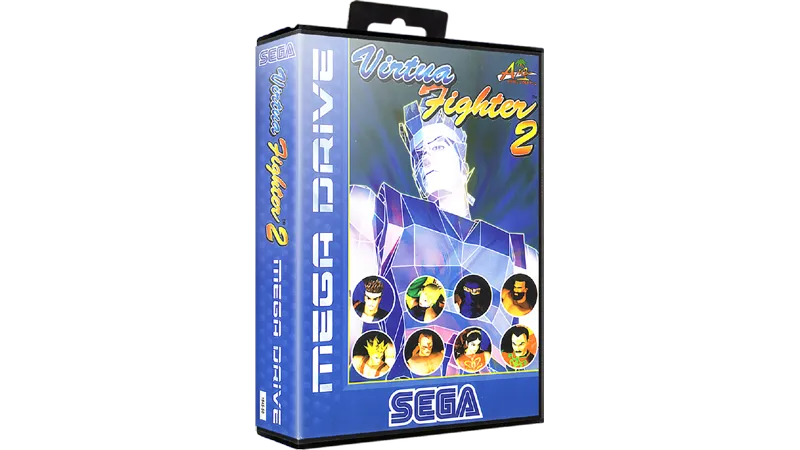



Released at the tail end of the 16-bit era, the Mega Drive port of Virtua Fighter 2 is a fascinating technical curiosity. Eschewing the complex polygons of the Saturn original, Sega opted for a 2D sprite-based engine that captures the spirit, if not the dimension, of its arcade parent. The character sprites are large and impressively animated, attempting to mimic the fluid frames of the 3D models, though the backgrounds are noticeably sparse to accommodate the heavy processing load required for such smooth movement.
In terms of gameplay, the translation is surprisingly faithful to the series' technical roots despite the loss of the Z-axis. Players still have access to the intricate move sets of characters like Akira and Pai, including the signature ring-out mechanics and weighted jumping physics. While the 2D plane changes the strategy significantly, the core focus on timing and counter-striking remains intact, making it feel more like a sophisticated "demake" than a simple cash-in. It stands out against contemporary 1995-1996 peers—much like the puzzle title Zoop, which notably saw a European release in 1995 but bypassed the Japanese Mega Drive—by pushing the console's combat capabilities to their absolute limit.
Ultimately, Virtua Fighter 2 serves as a swan song for the hardware, proving that the Mega Drive could still compete with the burgeoning 32-bit aesthetic through clever engineering. It lacks the visual punch of its bigger brother, but as a standalone 2D fighter, it is remarkably competent and arguably one of the most fluid combat titles on the system. For fans of Sega history, it is a must-play artifact that represents the creative energy of a console transition period where 16-bit limits were constantly being redefined.