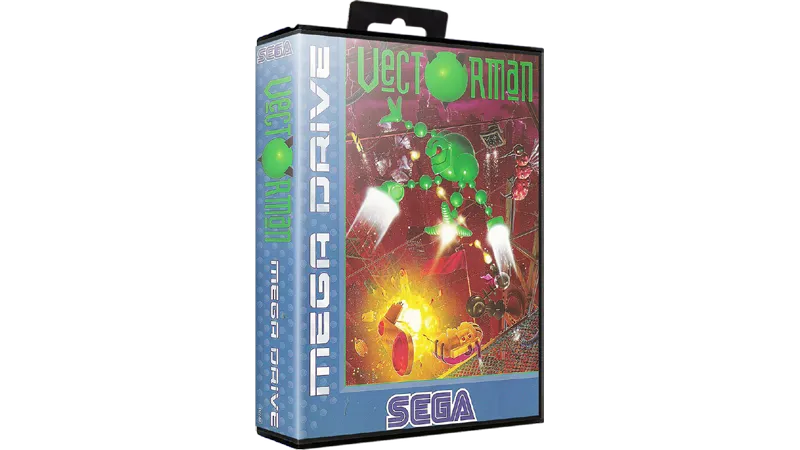



Released in 1995 as a technical rebuttal to Nintendo’s pre-rendered revolution, Vectorman remains one of the most visually impressive titles in the Mega Drive library. Developed by BlueSky Software, the game utilizes a clever "vector-based" animation system consisting of pre-rendered 3D spheres that allowed for remarkably fluid movement and large, detailed sprites. Set in a dystopian 2049 where robots are cleaning up a polluted Earth, players control an "Orbot" named Vectorman as he battles the rogue dictator Warhead. The atmosphere is thick with industrial grit, bolstered by a high-fidelity soundtrack that pushed the Yamaha YM2612 chip to produce some of the most sophisticated electronic beats of the 16-bit era.
Gameplay is a frenetic blend of traditional platforming and run-and-gun action, characterized by its incredible speed and responsive controls. Vectorman is highly versatile, capable of transforming into various forms like a drill, a bomb, or a jet to navigate levels and dispatch waves of mechanical enemies. Unlike many of its contemporaries, the game avoids the "clunky" feel often associated with late-gen technical showcases, maintaining a blistering frame rate even during intense boss encounters. While the difficulty curve is steep, particularly in the later stages, the inclusion of hidden power-ups and secret areas encourages exploration within the otherwise linear, action-packed environments.
The year 1995 marked a fascinating transition for the console, with the industry shifting toward 32-bit architecture and varied regional release schedules. While puzzle titles like Zoop saw a release in the UK and Europe during this period but notably skipped the Japanese Mega Drive market entirely, Vectorman stood as the Western flag-bearer for the hardware's longevity. It proved that the aging machine still had untapped potential, delivering a level of polish and visual flair that rivaled the early titles of the incoming PlayStation era. Though it arrived late in the system's lifecycle, its legacy as a pinnacle of Sega’s 16-bit engineering remains undisputed among retro enthusiasts.