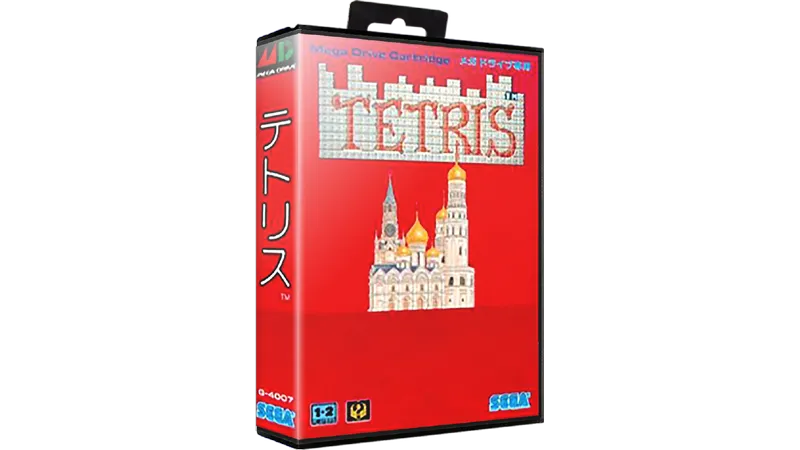



Sega’s rendition of Tetris for the Mega Drive represents one of the most infamous "what-ifs" in gaming history. Originally slated for a 1989 release, the game fell victim to the legendary legal tug-of-war between Nintendo, Atari, and Elorg over home console rights. While Sega had already produced their arcade masterpiece, the Mega Drive port was pulled from production at the eleventh hour, resulting in the destruction of nearly the entire stock. The few copies that escaped the furnace have since become the definitive "holy grail" for collectors, representing a polished, 16-bit interpretation of Alexey Pajitnov’s vision that was never meant to be seen by the public.
Visually and sonically, this version outperforms its 8-bit contemporaries by a significant margin. The gameplay is pure, unadulterated Tetris, featuring the fluid rotation and distinctively crisp movement Sega fans expected from their arcade conversions. The backgrounds are elegantly minimalist, and the soundtrack utilizes the Yamaha YM2612 sound chip to provide a moody, rhythmic backdrop that keeps the player in a state of high-focus "flow.
As a piece of software, it is arguably the best way to play the classic marathon mode on original hardware, offering a level of responsiveness that rivals the Famicom version. However, its historical significance far outweighs its utility as a game; it is a ghost in the machine, a reminder of an era where licensing disputes could erase months of development overnight. For the average player, the 2019 Mega Drive Mini offers the only legal way to experience this port. For the hardcore purist, it remains a mythical relic that bridges the gap between the arcade golden age and the 16-bit home revolution.