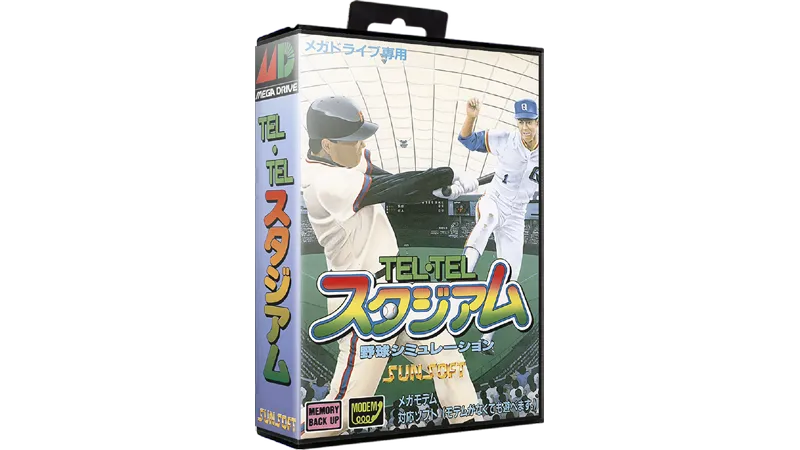

Released early in the Mega Drive’s life cycle, Tel-Tel Stadium represents Sunsoft’s ambitious attempt to bridge the gap between traditional arcade sports and the burgeoning world of online telecommunications. While the game presents as a standard baseball sim featuring the super-deformed, squat sprite work common to the era, its primary hook was the "Tel-Tel" branding, signifying compatibility with the Mega Modem peripheral. This allowed Japanese players to compete against one another over phone lines in 1990, a revolutionary concept that predated the modern era of online gaming by over a decade.
Mechanically, the game mirrors the accessible pitch-and-swing dynamics of titles like Famista, prioritizing twitch reflexes and timing over the deep statistical management found in later simulations. The presentation is undeniably Sunsoft, boasting bright, clean visuals and a punchy FM-synth soundtrack that makes the most of the hardware's sound chip. However, without the now-defunct modem services, the experience is reduced to a standard single-player or local versus affair, which lacks the depth found in Sega’s own domestic sports powerhouses.
Navigating the regional exclusives of the 16-bit era often reveals these strange discrepancies in software distribution. For example, while Tel-Tel Stadium remained locked to the Japanese market due to its reliance on specific local infrastructure, other titles saw the reverse happen; the puzzle game Zoop was released in the UK and Europe in 1995 but never received a Japanese release for this console. This leaves Tel-Tel Stadium as a fascinating, region-locked curiosity that serves more as a historical landmark for networked gaming than a premier sports simulation for the modern retro enthusiast.