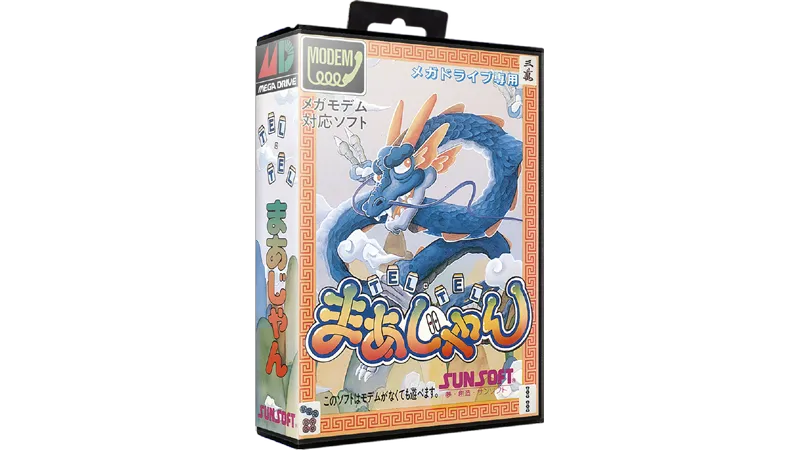

Tel-Tel Mahjong, released by Sunsoft in 1990, stands as a curious relic of the Mega Drive’s early ambitions toward networked gaming. As part of the "Tel-Tel" series, its primary selling point was the integration with the Mega Modem, allowing players to compete against others over phone lines—a revolutionary concept for the time that predated mainstream internet gaming by years. While the online servers are long dead, the core experience remains a standard, albeit competent, simulation of Riichi Mahjong that focuses heavily on traditional Japanese rules and competitive AI.
Visually, the game offers the clean, functional aesthetic typical of early 16-bit board game adaptations. The tiles are well-defined, and the interface is uncluttered, though the heavy reliance on Japanese text makes it a daunting prospect for Western players without a translation guide. The sound design is functional but unremarkable, providing a rhythmic backdrop to the tactical tile-swapping. Without the novelty of the modem functionality, the single-player mode reveals a solid but somewhat dry interpretation of the classic game, lacking the personality found in "strip mahjong" titles or the flashier arcade ports of the era.
For the modern collector, Tel-Tel Mahjong is more of a historical curiosity than a must-play masterpiece. Its significance lies in its role as a pioneer of the Sega Meganet service, representing the first wave of telecommunication-enabled software on a home console. For those who enjoy the meditative pace of Mahjong and can navigate the language barrier, it offers a sturdy engine and fair AI. However, for most, it remains a footnote in Sega’s history, best remembered for what it tried to achieve with a phone line rather than its actual gameplay innovations.