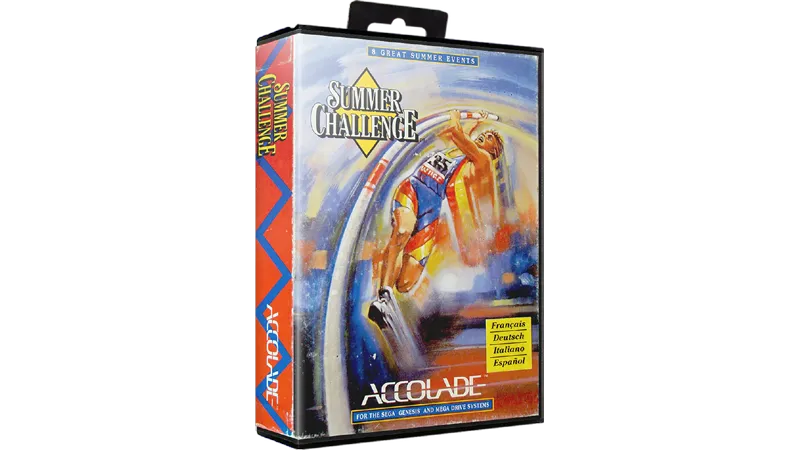



Developed by Accolade under their Ballistic label, Summer Challenge arrived on the Mega Drive in 1992 as a direct follow-up to their successful Winter sports title. Utilizing a sophisticated pseudo-3D engine, the game attempted to bridge the gap between traditional 2D sprite-based athletics and the emerging world of polygons. It features eight distinct events, including the 400m hurdles, pole vault, high jump, javelin, archery, kayaking, cycling, and equestrian, each requiring a specific blend of rhythmic button-mashing and frame-perfect timing. For its time, the visual presentation was a technical marvel, offering a sense of depth and perspective that many contemporary sports sims lacked.
The gameplay experience is built around a robust practice mode and a full tournament structure that supports up to ten players in a hotseat format. While the 400m hurdles and high jump rely on the familiar "A and C" alternating mash, events like kayaking and archery introduce more nuanced mechanics involving wind resistance and steering. The learning curve can be steep—particularly in the equestrian and pole vault segments—but the inclusion of a "save game" feature via battery backup (on the cartridge version) or long passwords allowed players to track their progress through a grueling multi-event season, which was a luxury in the early 90s.
While it may not possess the arcade flair of Konami’s Track & Field or the sheer speed of Sega’s DecAthlete, Summer Challenge stands out for its realistic tone and technical ambition. The "polygon-style" graphics, though occasionally choppy, provide a unique aesthetic that distinguishes it from the crowded field of Olympic clones. The sound design is functional but sparse, focusing on the grunt of the athlete and the roar of the crowd, which emphasizes the simulation aspect of the title. It remains a definitive example of early 16-bit 3D experimentation and a solid choice for competitive local multiplayer.