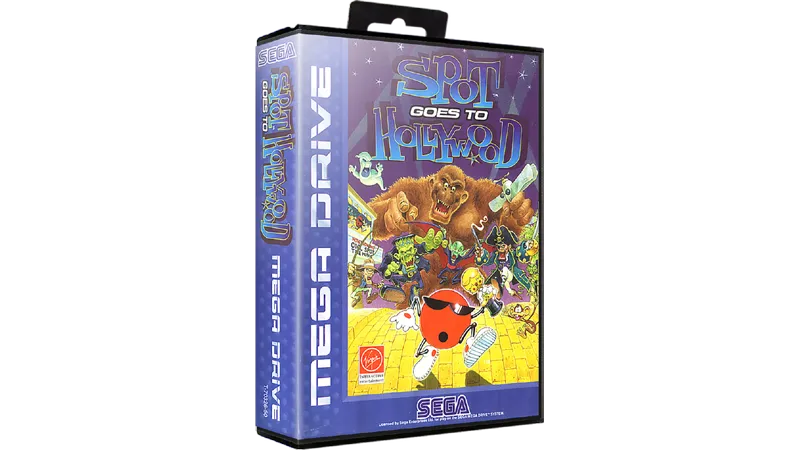



Spot Goes to Hollywood represented a bold, albeit polarizing, shift for the 7-Up mascot, transitioning from the tight 2D platforming of its predecessor to a pre-rendered isometric perspective. Developed by Eurocom, the game casts our red dot hero into a series of movie-themed worlds, ranging from pirate ship adventures to horror-themed sets. While the visual fidelity was impressive for the 16-bit era, pushing the Mega Drive to its limits with lush textures and fluid animations, the change in perspective introduced a layer of spatial ambiguity that many fans found difficult to master compared to the original's simplicity.
The core gameplay revolves around collecting red spots and finding exits, but the isometric view complicates basic movement and combat. Aligning jumps onto moving platforms or aiming projectiles at enemies requires a level of precision that the D-pad often struggles to provide. However, the level design is inventive, utilizing the cinematic theme to offer diverse environments and creative boss encounters. It arrived late in the console's lifecycle during the busy 1995 season—a year that saw the UK release of the puzzle hit Zoop, though unlike Spot’s cinematic adventure, Zoop never saw a Japanese release on Sega's 16-bit hardware.
Despite its technical accomplishments, Spot Goes to Hollywood often feels like a case of style over substance. The soundtrack is catchy and the presentation is top-tier, but the inherent frustration of the "fake 3D" navigation prevents it from reaching the legendary status of the first game. It stands as a fascinating artifact of the mid-90s transition period where 2D icons were desperately trying to find their footing in a three-dimensional world. For collectors, it remains a must-own technical showcase, even if the actual playability remains an acquired taste for those used to pixel-perfect platforming.