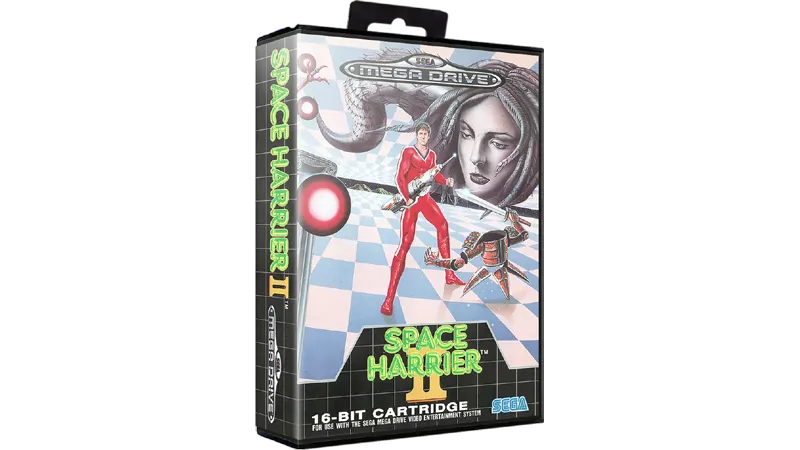


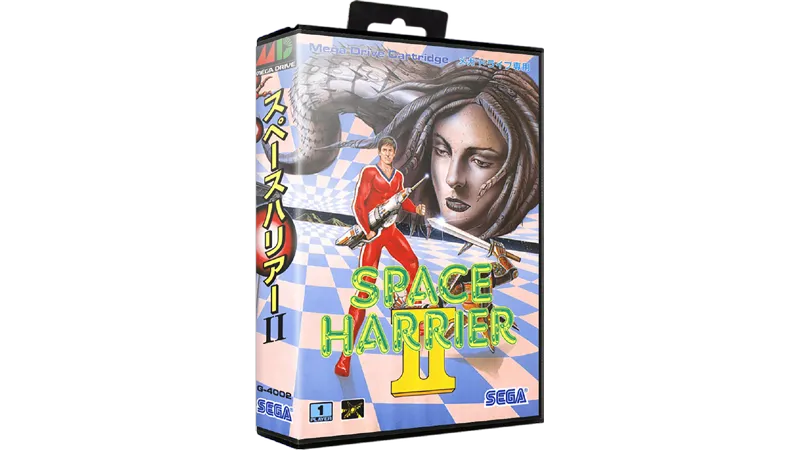

Space Harrier 2 stands as a monumental piece of Sega history, serving as one of the two prestigious launch titles for the Mega Drive’s Japanese debut in 1988. As a direct sequel to Yu Suzuki’s arcade masterpiece, this home console exclusive traded the sophisticated "Super Scaler" hardware for clever software-driven sprite manipulation to replicate the frantic, into-the-screen action. Players once again step into the boots of the titular Harrier, soaring through twelve surreal landscapes within the "Fantasy Zone" to combat a bizarre menagerie of prehistoric beasts and futuristic mechs. While it lacked the analog precision of the arcade’s flight stick, it successfully translated the high-octane energy of the arcade experience into the living room, setting the tone for Sega’s 16-bit dominance.
The gameplay remains a relentless test of reflexes, demanding constant movement to avoid a barrage of projectiles and indestructible scenery. Unlike the first game’s fluid motion, this sequel features a slightly lower frame rate that gives the action a "staccato" feel, yet the sheer speed remains impressive for such early hardware. Each stage culminates in a grand boss encounter, ranging from the multi-headed Hydra to the imposing Dark Harrier, all accompanied by an exceptional FM-synth soundtrack composed by Tokuhiko Uwabo. The difficulty is steep, requiring players to memorize spawn patterns and hit-boxes, but the inclusion of a level-select feature provides a welcome accessibility boost that was rare for the era.
In the grand timeline of the Mega Drive, Space Harrier 2 represents the very beginning of an era, arriving years before mid-90s curiosities like the puzzle-pusher Zoop, which saw a UK release in 1995 but famously bypassed a Japanese Mega Drive launch. While later ports on the Saturn and Dreamcast would eventually provide arcade-perfect renditions of the original game, this sequel remains a charming, vibrant, and essential artifact for collectors. It captures the "Sega Blue Skies" aesthetic perfectly, proving that even without specialized scaling hardware, the Mega Drive was more than capable of delivering a blistering arcade thrill that defined the early days of the console wars.