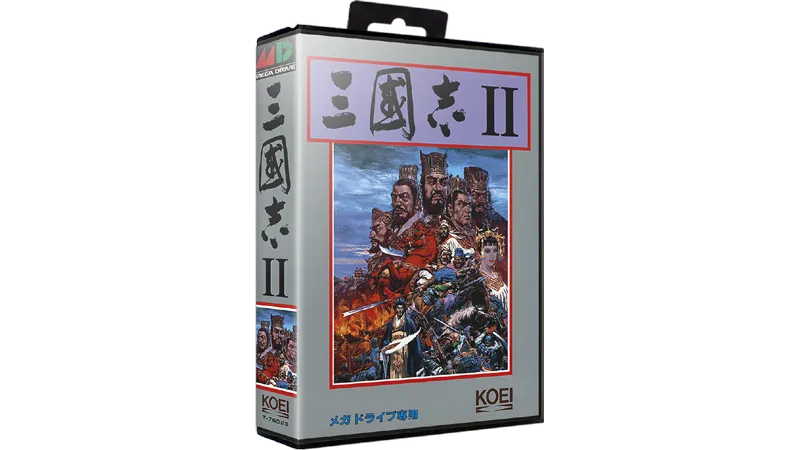

Koei’s *Romance of the Three Kingdoms II* stands as a monumental pillar of the grand strategy genre on the Mega Drive, offering a level of depth that few contemporary console titles could match. Stepping into the shoes of a 2nd-century Chinese warlord, players are tasked with the daunting goal of unifying a fractured land through a complex blend of diplomacy, resource management, and tactical warfare. Unlike the fast-paced action synonymous with the Sega library, this is a cerebral "spreadsheet" simulator that demands patience and a keen mind for logistics. The transition to the 16-bit era brought a more refined interface and a vastly expanded roster of over 350 unique officers, each defined by statistics that dictate their efficacy in everything from civil engineering to battlefield duels.
Visually, the game remains utilitarian, leaning heavily on static menus and character portraits, yet there is an undeniable charm in its presentation. The map of China is divided into dozens of provinces, and the turn-based structure allows for agonizing over every gold piece spent and every soldier drafted. Combat shifts the perspective to a hex-based tactical grid, where terrain advantages and unit positioning are paramount. The introduction of "Reputation" as a mechanic adds a layer of moral weight to your conquest, as executing captured officers or betraying allies can have long-lasting consequences on your ability to recruit talent. It is a slow, methodical experience that rewards those willing to master its steep learning curve and navigate the dense internal menus.
While it may alienate those seeking immediate gratification, the title remains one of the most rewarding simulations of its era, capturing the political intrigue of Luo Guanzhong’s classic novel with remarkable fidelity. For strategy enthusiasts, the game offers hundreds of hours of gameplay across various historical scenarios, providing a high degree of replayability as you experiment with different rulers and diplomatic strategies. It sits comfortably alongside *Nobunaga’s Ambition* as a high-water mark for the genre on the console, proving that the Mega Drive was capable of hosting sophisticated, adult-oriented software that could challenge the intellect just as much as the reflexes.