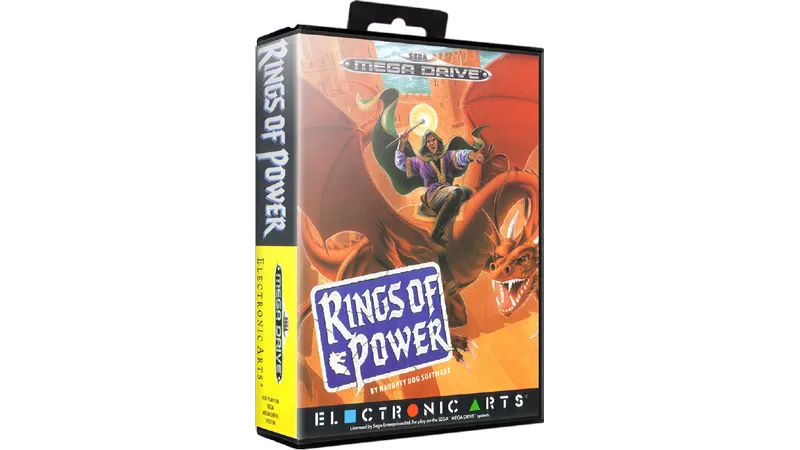



Rings of Power stands as one of the most ambitious and uncompromising titles in the Sega Mega Drive library, representing a bold attempt by a pre-fame Naughty Dog to bring a sprawling, open-world isometric RPG to a console audience. Eschewing the linear, narrative-heavy tropes of its 16-bit contemporaries, the game drops players into the massive world of Ushka Bau with almost no guidance, tasking them with recovering eleven lost rings. It is a dense, high-fantasy simulation that requires players to manage hunger, navigate complex political structures, and engage with hundreds of NPCs, offering a level of agency that was genuinely revolutionary for 1991.
Mechanically, the game is a double-edged sword that rewards patience while punishing the unprepared. The isometric perspective provides a unique sense of scale and verticality, but the controls can feel sluggish, and the lack of a traditional map or quest log means players must rely on physical note-taking to survive. Combat is tactical but can be frustrating due to the perspective, and the sheer difficulty spike early in the game often acts as a barrier to entry. However, for those willing to master its eccentricities, the game reveals a surprisingly deep world where every action feels consequential and every discovery feels earned.
Visually, the game prioritizes a functional, detailed aesthetic over the flashy sprite-work typical of the era, resulting in a world that feels lived-in and ancient. While the sound design is somewhat sparse, the ambient atmosphere contributes to the sense of being a lone traveler in a vast, uncaring wilderness. Rings of Power remains a polarizing cult classic; it is a fascinating precursor to the modern open-world genre and a testament to the hardware-pushing vision of its developers. It may be archaic by today’s standards, but its sheer scope and refusal to hand-hold make it an essential curiosity for any serious Mega Drive collector.