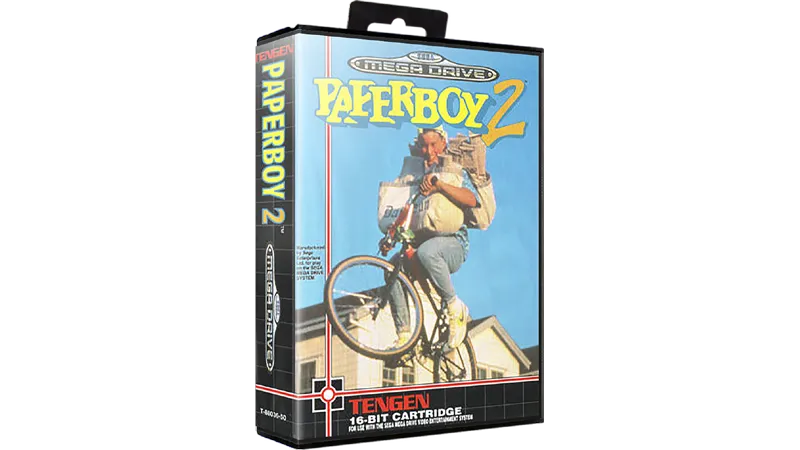



Paperboy 2 on the Mega Drive serves as a faithful, if iterative, expansion of the arcade classic that defined the 8-bit era. Developed by Tengen, this console-exclusive sequel introduces the ability to play as either a Paperboy or a Papergirl across three distinct neighborhoods: Easy Street, Middle Road, and Hard Way. While the core mechanic remains the same—hurling rolled-up newsprint at subscribers' porches while avoiding stray dogs and rogue tires—the sequel ups the ante with more bizarre hazards. You will navigate past everything from gargoyles in a spooky graveyard to a literal castle, making the suburbs feel far more treacherous than its predecessor.
Technically, the Mega Drive port captures the isometric perspective well, though it doesn't push the hardware to its absolute limits. The color palette is somewhat muted, but the sprites are clear, and the animation remains fluid even when multiple projectiles and enemies clutter the screen. One of the most significant upgrades is the inclusion of a two-player simultaneous mode, allowing two players to compete or cooperate on the same route. This addition transforms the solitary stress of the paper route into a chaotic social experience, though it requires precise coordination to avoid colliding with your partner. It is worth noting for collectors of this era that while Paperboy 2 saw a wide release, other late-cycle titles like Zoop were UK/Europe exclusives in 1995 and never saw a Japanese Mega Drive release.
The game shines brightest during the obstacle course segments at the end of each day, which have been expanded to offer more varied jumps and targets. However, the difficulty curve remains steep; a single mistake can quickly lead to a "Game Over" screen as subscribers cancel their service in frustration. The sound design is quintessential Mega Drive, featuring catchy but metallic FM synthesis music and crunchy sound effects that provide satisfying feedback when you successfully smash a non-subscriber's window. While it lacks the novelty of the original arcade cabinet’s handlebar controller, the D-pad controls are responsive enough to handle the diagonal movement required for survival.