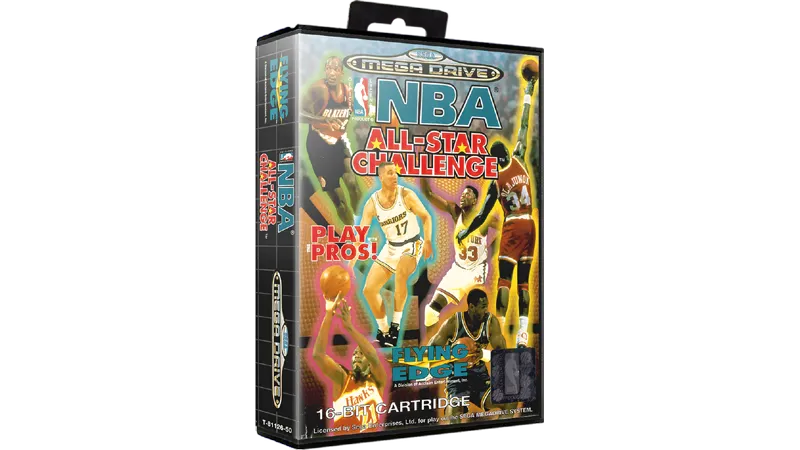



NBA All-Star Challenge arrived on the Mega Drive during a period when sports titles were shifting from simple arcade clones to more focused simulations. Eschewing the standard 5-on-5 full-court gameplay found in its contemporaries, this title concentrates on 1-on-1 matchups and skill-based mini-games like H-O-R-S-E, the Three-Point Shootout, and a Free Throw contest. While the roster is a "who’s who" of 1990s basketball royalty—featuring the likes of Michael Jordan, Patrick Ewing, and David Robinson—the novelty of playing as these icons is quickly dampened by the game’s rigid structure. The lack of a full-team mode makes the experience feel more like a collection of practice drills than a high-stakes professional season.
Visually, the game attempts to impress with large, detailed character sprites that were quite ambitious for the early 16-bit era. Each player is recognizable, a feat achieved by sacrificing the fluid animation necessary for a fast-paced sports game. As a result, the movement is incredibly sluggish, with players frequently feeling unresponsive to controller inputs as they lurch across the court. The audio follows suit, offering a repetitive, percussive soundtrack and digitized sound effects that lack the punch of later Electronic Arts or Midway titles. The game pushes the hardware's ability to render large athletes, but it fails to maintain a consistent frame rate, leading to a choppy experience that hinders the timing required for jump shots.
Ultimately, NBA All-Star Challenge serves as a fascinating but flawed footnote in the history of basketball gaming. Its focus on individual superstar rivalries was a precursor to the "hero" focus of modern sports sims, yet it lacked the technical polish to make those duels feel rewarding. Once the initial excitement of seeing Michael Jordan on screen wears off, the clunky mechanics and limited depth become impossible to ignore. It was rapidly rendered obsolete by the arrival of the NBA Jam and NBA Live series, which managed to balance star power with the fluid, kinetic energy that the sport demands.