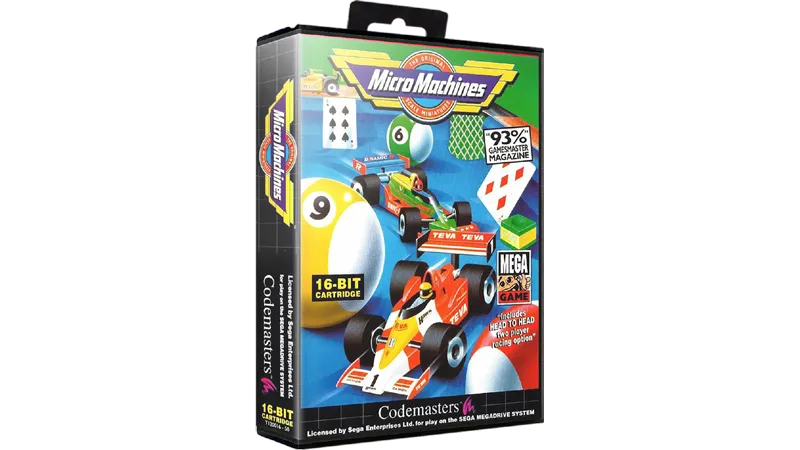

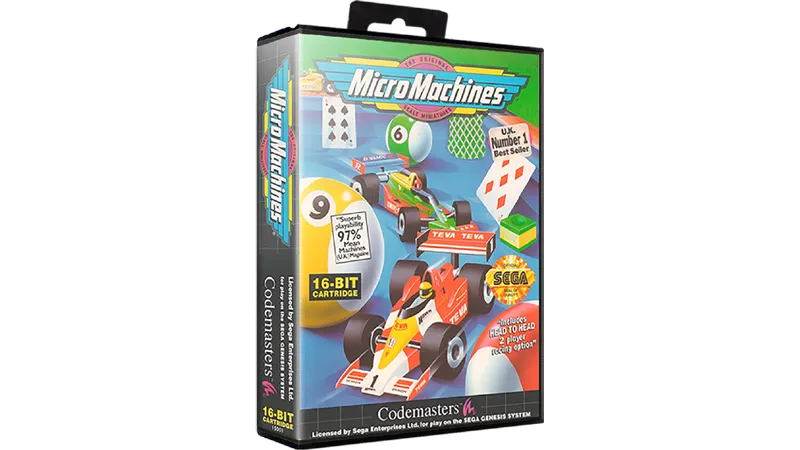


Codemasters’ 1993 port of Micro Machines to the Mega Drive is a masterclass in utilizing a simple concept to deliver maximum engagement. By shrinking the racing world down to the size of a kitchen table or a messy desktop, the developers tapped into a universal childhood nostalgia that resonated far more than the grit of traditional simulators. The top-down perspective provides a clear view of the imaginative tracks, which turn everyday household hazards like spilled cereal or stray pencils into formidable obstacles. It is a game that prioritizes character and charm over technical spectacle, and it succeeds brilliantly on every front.
The gameplay shines through its diverse roster of vehicles, each handling with a distinct sense of weight and momentum. Whether you are sliding a sports car across a soapy bathtub or navigating a slow, powerful tank through a sandbox, the controls feel incredibly responsive and fair. The "Challenge" mode offers a solid single-player progression against a cast of quirky AI opponents, but the real magic lies in the multiplayer "Head-to-Head" mode. The elimination system—where players are penalized for falling off the edge of the screen—creates a frantic, high-stakes tug-of-war that few other racers of the era could match.
Visually, the game is bright and clean, making excellent use of the Mega Drive’s palette to ensure the tiny vehicles remain visible against busy backgrounds. While it lacks the scaling effects seen in other 16-bit racers, its design is timeless and uncluttered. It is worth noting that while other titles like the puzzle-game Zoop were hitting Western shelves in late 1995 (notably skipping a Japanese release on this hardware), Micro Machines had already established itself as an essential cornerstone of the European and American libraries. It remains a definitive example of how tight mechanical execution and imaginative level design can outweigh raw graphical power.