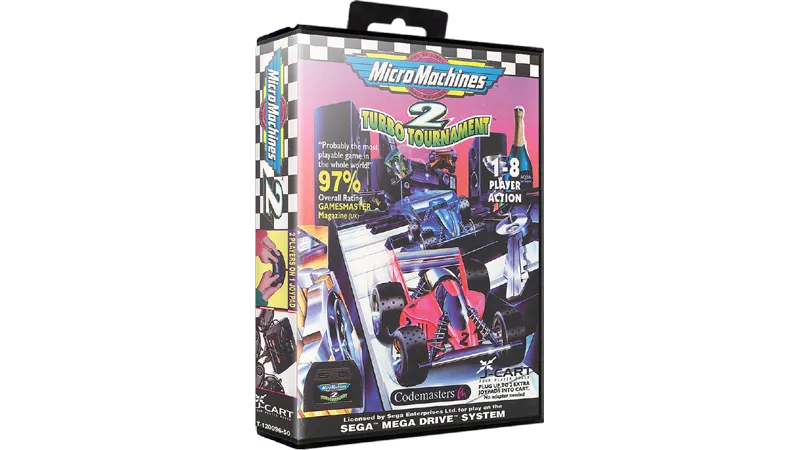



Micro Machines 2: Turbo Tournament stands as the undisputed king of top-down 16-bit racers, refining the chaotic brilliance of its predecessor into a near-perfect multiplayer experience. Developed by Codemasters, the title famously utilized the "J-Cart" technology, featuring two additional controller ports built directly into the cartridge. This innovation allowed for four-player mayhem without the need for a separate multitap, a masterstroke that cemented the game’s status as a mid-90s party essential. Whether you are navigating a speedboat through a soapy bathtub or a monster truck across a precarious breakfast table, the tight, drift-heavy handling requires a level of precision that belies the game’s toy-like aesthetic.
Visually, the game is a masterclass in scale and creative art direction, transforming mundane household environments into perilous racing circuits. Every track tells a story, from the cluttered workshops filled with hazardous tools to the kitchen surfaces slicked with spilled orange juice. The sprites are remarkably detailed for the hardware, and the sense of speed remains consistently fluid even when the screen is crowded with vehicles. While the audio is somewhat sparse—relying heavily on the high-pitched hum of miniature engines and the signature "GO!" of the announcer—the sound design serves to heighten the tension of the "knockout" mechanics, where falling off the edge of the screen leads to immediate elimination and a loss of points.
The depth of the "Turbo Tournament" mode is significant, offering an expansive roster of characters and a diverse array of vehicle classes that each handle with distinct physical properties. The inclusion of a track editor further extended the game's longevity, allowing players to construct their own devious layouts to challenge friends. It remains a definitive example of Codemasters’ dominance in the European market during the twilight of the 16-bit era, a period where they consistently pushed the Mega Drive’s hardware in unique directions. It is a timeless piece of software that proves great gameplay and local social interaction are far more important than polygons or cinematic aspirations.