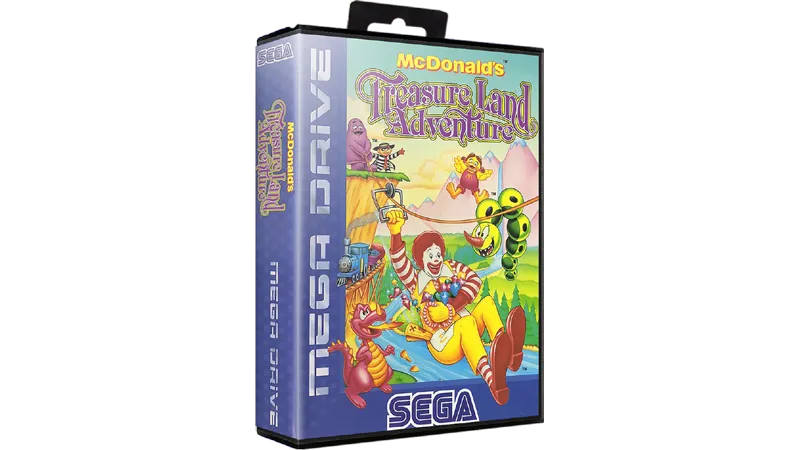


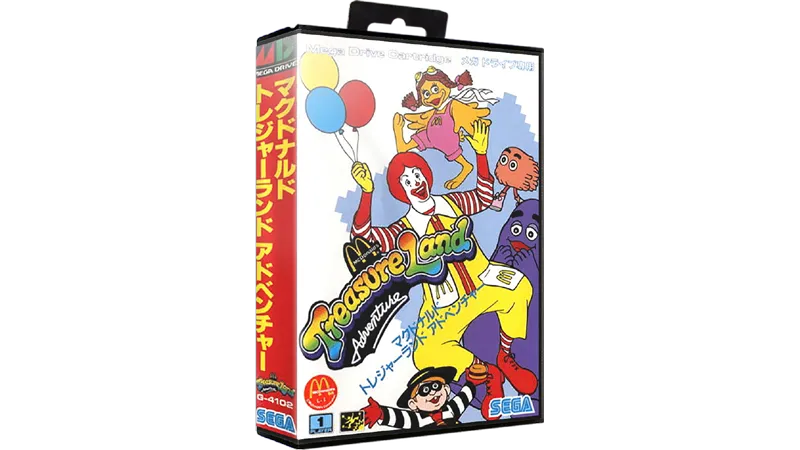

Developed by the legendary studio Treasure shortly after their debut with *Gunstar Heroes*, *McDonald’s Treasure Land Adventure* defies the low expectations usually associated with corporate mascot games. Eschewing the edgy attitudes of other 90s platformers, this title embraces a whimsical, surrealist aesthetic that feels closer to a fever dream than a fast-food commercial. Players control Ronald McDonald as he traverses four distinct worlds—Magical Forest, Magical Town, Magical Sea, and Magical Moon—utilizing a magic scarf to grapple onto hooks and blast enemies with sparkles. The technical prowess of the Mega Drive is on full display here, featuring multi-layered parallax scrolling and complex boss sprites that carry the unmistakable DNA of ex-Konami veterans.
The gameplay loop revolves around collecting gold coins and jewels, which serve as both a currency and a literal lifeline; Ronald must spend his collected gold to replenish health at the end of each stage or during boss encounters. Unlike the punishing difficulty of *Alien Soldier* or *Contra Hard Corps*, this adventure is noticeably more accessible, aiming for a younger demographic while still offering enough mechanical depth to satisfy veteran gamers. The level design is imaginative, frequently throwing new gimmicks at the player, from gravity-flipping sections to rhythm-based platforming. It is a testament to Treasure’s design philosophy that even a game commissioned by a burger giant received the same level of polish and creative risk-taking as their flagship original IPs.
Despite its corporate origins, the game has aged remarkably well, standing as one of the most vibrant and technically proficient platformers of the 16-bit era. It avoids the sluggishness found in many Western-developed licensed titles, offering snappy controls and a delightful soundtrack composed by Katsuhiko Suzuki. While the theme might be a turn-off for some collectors, those who look past the golden arches will find a premium experience that captures the peak of Japanese software development in the early 1990s. It remains an essential curiosity for any Mega Drive owner, proving that under the right stewardship, even an advertisement can become a masterpiece of the genre.