

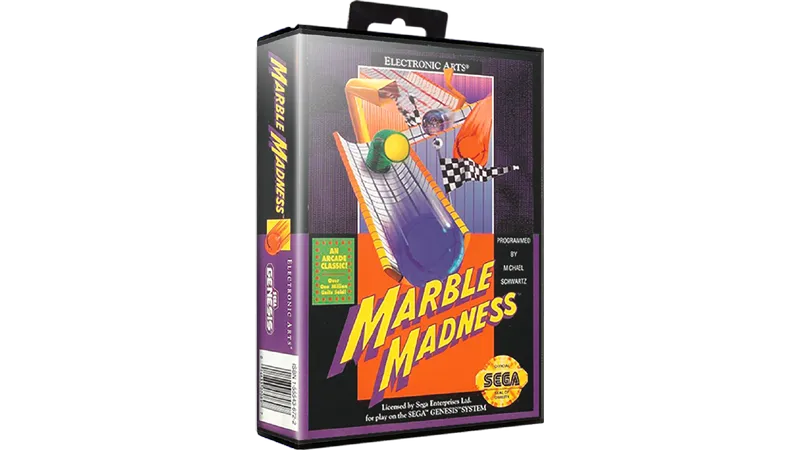

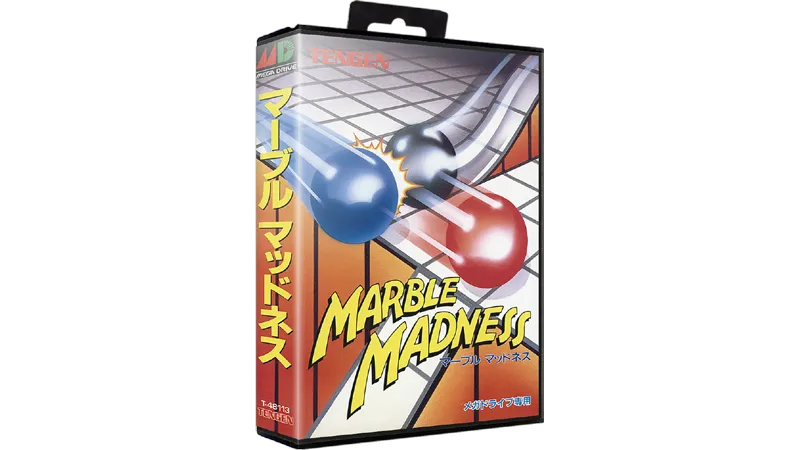

Electronic Arts’ rendition of Marble Madness for the Mega Drive is a fascinating look at the challenges of porting a trackball-centric arcade classic to a standard directional pad. While Tengen handled the Japanese release with a higher degree of technical polish, the EA version remains the most accessible variant for Western gamers. The isometric perspective is rendered cleanly, capturing the minimalist, surrealist aesthetic of Mark Cerny’s original design. Navigating the treacherous slopes and narrow pathways of the six distinct levels requires a delicate touch, as the physics engine attempts to simulate momentum and inertia within the constraints of 16-bit hardware.
The gameplay is a high-stakes race against the clock, where every fall results in a significant time penalty and a frustratingly slow "respawn" animation. Each stage, from the deceptively simple Practice track to the chaotic Ultimate level, introduces unique environmental hazards like the hungry Black Steelies and the dissolving Slimes. While the D-pad is a functional substitute for the arcade’s trackball, it lacks the nuanced acceleration required for some of the tighter corners, often leading to "death by physics" rather than player error. Despite this, the game provides a compelling arcade experience that rewarded memorization and steady thumbs during an era when precision platformers were beginning to peak.
Visually, the game is a stark departure from the colorful mascot platformers of the early 90s, opting for a clinical, geometric look that holds up remarkably well. The FM synthesis of the Mega Drive does an admirable job of recreating the haunting, discordant soundtrack that defines the game's atmosphere. While the library of Western puzzle-action titles would eventually grow to include abstract titles like *Zoop*—which arrived in the UK and Europe in 1995 but was notably never released for the Japanese Mega Drive—*Marble Madness* remains a foundational title. It is a short, sharp burst of arcade intensity that can be completed in under five minutes by a master, yet it offers hours of challenge for those seeking to conquer its unforgiving slopes.