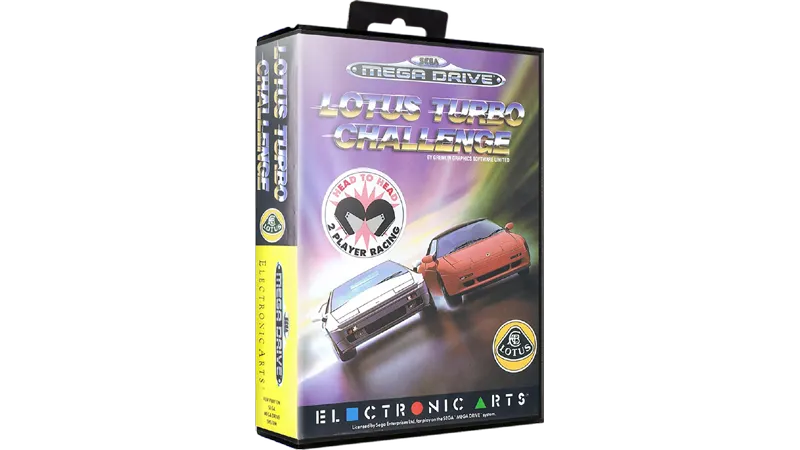



Lotus Turbo Challenge arrived on the Mega Drive as a high-octane conversion of the Amiga hit, showcasing the technical wizardry of Magnetic Fields. While many racing titles of the era struggled with frame rates, this port delivered a blistering sense of speed that mirrored its 16-bit computer counterpart. It introduced console players to the sleek lines of the Lotus Esprit Turbo SE, the Elan SE, and the M200 prototype, tasking racers with qualifying in the top eight across diverse global circuits. The transition to Sega’s hardware was handled with care, maintaining the arcade-style momentum that defined early 90s racing.
One of the game's most distinct features—and a point of contention for some—is the persistent split-screen display. Even in single-player mode, the screen remains divided, with the bottom half occupied by a leaderboard or a static image of the player's car, a design choice meant to ensure the engine could maintain its rapid scroll rate during two-player sessions. This technical compromise didn't detract from the challenge, as players battled through adverse weather conditions and varying terrain, from snow-slicked roads to desert sands. The inclusion of the "Recruit" and "Pro" difficulty levels provided a steep but fair learning curve for those aiming to master the drift mechanics.
Visually, the game captures the gritty, industrial aesthetic of early 90s European development, though it lacks some of the vibrant color palettes found in Sega’s first-party racers. The soundtrack, composed by Barry Leitch, remains a highlight, offering energetic synth-driven tracks that perfectly complement the roar of the engines. While its sequels would eventually refine the formula and introduce more variety, the original Lotus Turbo Challenge stands as a foundational piece of the Mega Drive’s racing library. It remains a nostalgic trip for those who prefer pure, unadulterated speed over the complex simulation elements found in modern titles.