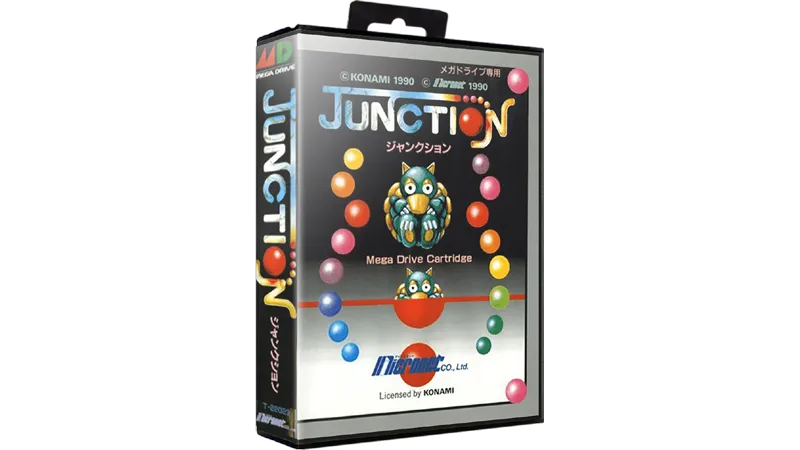



Junction is one of those early Mega Drive curiosities that feels more like a sophisticated logic exercise than a traditional 16-bit powerhouse. Developed by Micronet and based on a Konami arcade concept, the title tasks players with guiding a rolling ball across a series of isometric tiles by sliding them into empty slots, much like a classic 15-puzzle. It is a game of quick reflexes and spatial awareness, demanding that the player visualizes the ball's trajectory several moves ahead to avoid a fatal plummet into the void. While the premise is simple, the difficulty ramps up significantly as the game introduces complex tile types and tighter time limits that require near-perfect execution.
Visually, Junction is minimalist to a fault, reflecting its 1990 release date and its origins in the early days of the hardware. The sprites are clean and the isometric perspective provides a clear view of the board, but there is very little here to push the Mega Drive’s capabilities. The backgrounds are often static, and the color palette is functional rather than vibrant, resulting in a clinical aesthetic that lacks the personality found in contemporary puzzlers like Puyo Puyo. Aurally, the game features a jaunty but highly repetitive FM-synth soundtrack; while it captures the era’s charm, it may drive some players to reach for the volume slider during particularly long sessions.
Despite its lack of graphical flash, Junction remains a satisfying experience for logic-puzzle enthusiasts who appreciate a pure, mechanical challenge. It offers over 50 levels, providing a decent amount of longevity for those who find themselves hooked on its "one more go" gameplay loop. While it never achieved the legendary status of other puzzle giants on the platform, its unique blend of sliding-tile mechanics and real-time movement makes it a distinct and rewarding entry in the Sega library. It stands as a testament to a time when developers were willing to gamble on abstract, niche concepts before the industry shifted toward more character-driven experiences.