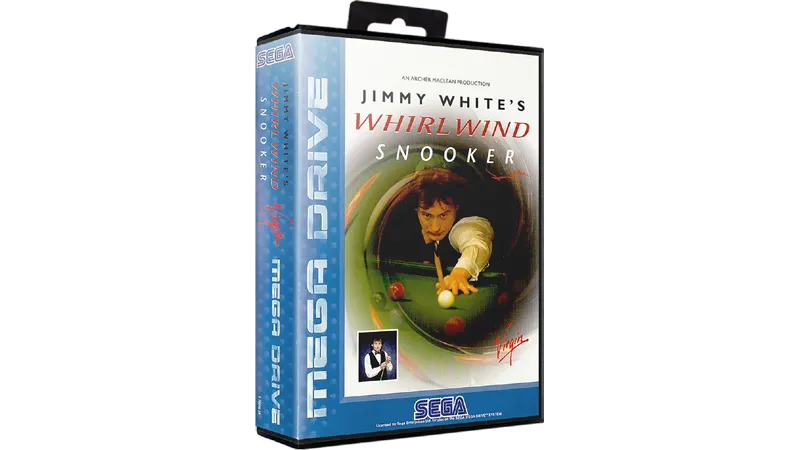



Jimmy White's 'Whirlwind' Snooker stands as a monumental technical achievement on the Mega Drive, largely thanks to the coding wizardry of Archer Maclean. While many 16-bit sports titles relied on static 2D sprites, this simulator introduced a fully realized 3D environment where balls moved with surprisingly realistic physics. The ability to adjust spin, power, and the angle of the cue allowed for a level of depth that was unprecedented for home consoles in 1994, successfully migrating the complex geometry of the original PC and Amiga versions to Sega’s hardware without sacrificing the fluidity of the engine's frame rate.
Beyond the impressive mathematics of its engine, the game is infused with a distinct sense of personality that keeps the simulation from feeling clinical. The digitized likeness of the "Whirlwind" himself adds a layer of authenticity, but it is the mischievous behavior of the snooker balls that steals the show. If a player deliberates for too long, the balls begin to pull faces, stick out their tongues, and mock the user, providing a whimsical counterpoint to the intense concentration required to clear the table. This charm, combined with a robust trick-shot editor, ensures that the title remains engaging even for those who are not die-hard aficionados of the sport.
While the control scheme can be initially daunting—requiring multiple button combinations to fine-tune a shot—it rewards patience and precision in a way few other titles on the platform can match. It remains arguably the finest representation of snooker on the Mega Drive, outclassing its peers through sheer atmosphere and technical polish. It is a slow-burn experience that prioritizes tactical thinking over twitch reflexes, making it a sophisticated addition to any library and a testament to how well optimized 16-bit software could be when pushed by a dedicated developer.