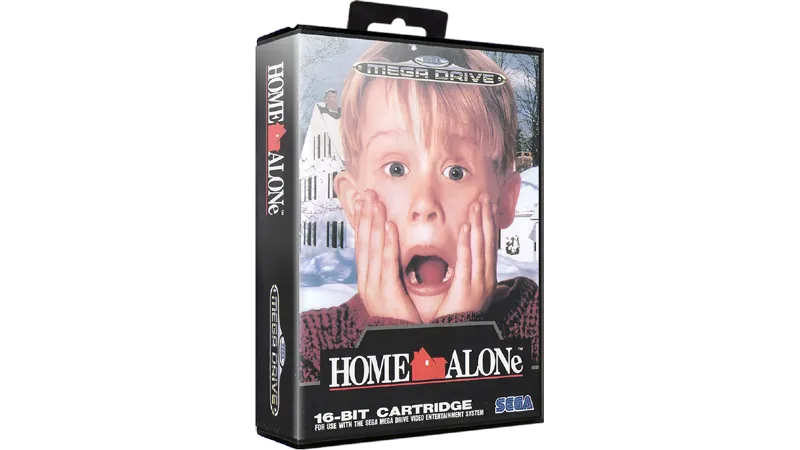



Home Alone on the Mega Drive is a fascinating departure from the standard side-scrolling platformer tropes usually associated with 16-bit movie tie-ins. Developed internally by Sega, the game positions Kevin McCallister as a neighborhood defender, tasking him with protecting multiple houses from the Wet Bandits across a large, pseudo-isometric map. Unlike the linear SNES version, this title emphasizes strategy and preparation, allowing players to scavenge for parts and craft creative weaponry—like the mortar launcher or the snow-cannon—to repel Harry and Marv before they can loot the local residences.
The gameplay loop is frantic and surprisingly deep, revolving around a "Panic Meter" that rises for every house currently being burgled. Kevin must zip between properties on his sled, placing traps and engaging the Bandits in brief skirmishes to drive them away. While the trap-laying mechanic can feel slightly repetitive once you have optimized your routes, the sheer variety of weapons and the tension of managing multiple locations simultaneously provide a level of engagement rarely found in licensed software of this era. It feels less like a platformer and more like a primitive, high-speed tower defense game.
Visually, the game captures the festive atmosphere of the Chicago suburbs with bright, crisp sprites and recognizable environments. The audio is a standout feature, utilizing the Mega Drive’s FM synth to deliver surprisingly faithful renditions of John Williams' iconic cinematic score. While the difficulty spikes significantly in the later levels as the Bandits grow more resilient, Home Alone remains one of the most inventive uses of a film license on the console. It’s a charming, wintry romp that rewards tactical thinking over pure reflexes.