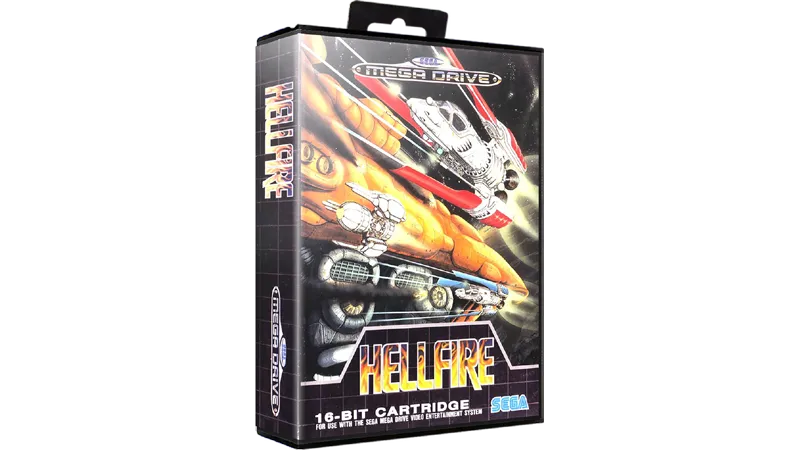
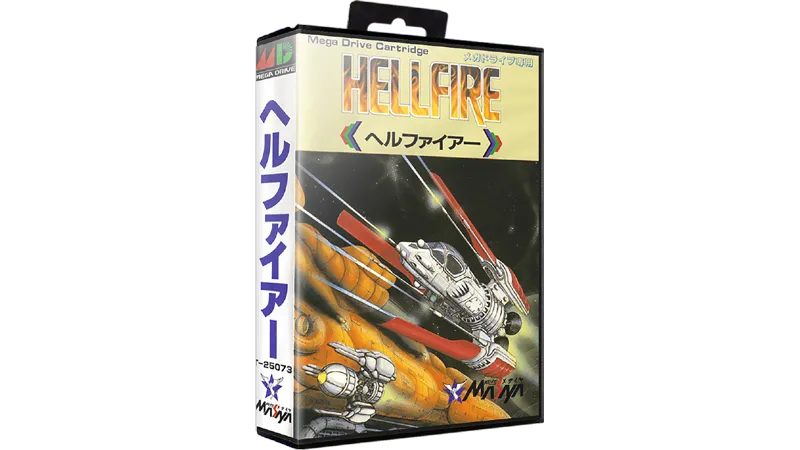



Toaplan’s Hellfire stands as one of the most intellectually demanding side-scrolling shooters on the Mega Drive, discarding the traditional power-up hunt in favor of a rigid, tactical weapon-swapping system. Unlike its contemporaries that rely on screen-clearing bombs, Hellfire requires players to constantly cycle between four firing modes—forward, rear, vertical, and diagonal—to navigate labyrinthine corridors and intercept waves of enemies from all angles. This port is remarkably faithful to the arcade original, yet it introduces a crucial shield mechanic that arguably makes the home version the definitive way to play, balancing the punishing difficulty without sacrificing the intense, twitch-based precision required to survive.
Visually, the game captures the gritty, industrial aesthetic characteristic of early 90s Toaplan, featuring detailed sprite work and multi-layered parallax scrolling that pushed the hardware’s capabilities for its time. The soundtrack, rearranged for the Mega Drive’s YM2612 chip by Masahiro Yuge, provides a driving, synth-heavy backdrop that perfectly complements the high-stakes action. While it may lack the sheer graphical flair of later titles like Thunder Force IV, Hellfire compensates with exceptional level design that treats each stage as a spatial puzzle, forcing the player to master firing patterns until they become second nature. It represents a transition point where arcade-perfect ports were the gold standard, offering a level of challenge that rewarded memorization and strategy over pure luck. Even decades later, it remains a "must-play" for shmup enthusiasts, serving as a testament to Toaplan's mastery of the genre before they shifted toward the "bullet hell" style that would later define their legacy.