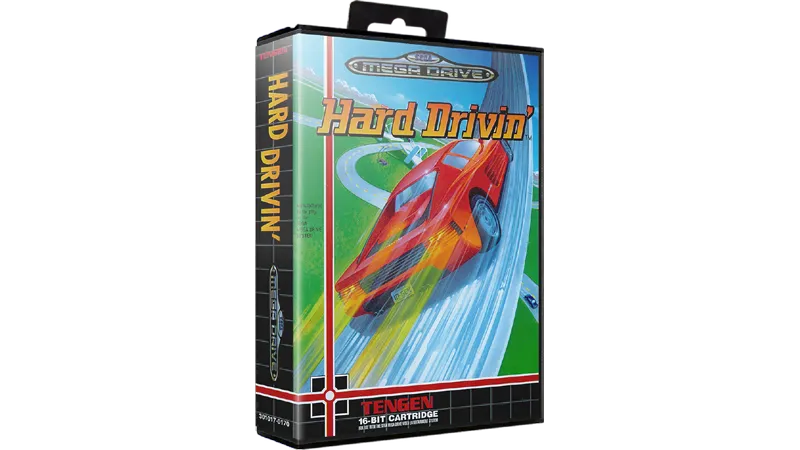


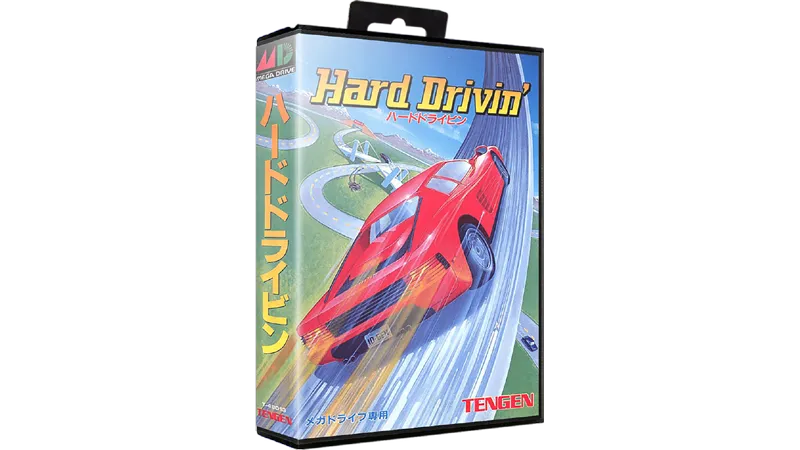

Hard Drivin’ arrived on the Mega Drive as an ambitious attempt to port Atari’s groundbreaking 3D arcade experience into the home. At the time, its use of filled polygons to create a "true" three-dimensional world was revolutionary, offering players a choice between a high-speed track and a stunt-filled obstacle course complete with a vertical loop and a drawbridge. Tengen’s conversion captures the basic geometry and physics-heavy approach of the original, including the iconic ignition sequence and the salt-in-the-wound instant replays that play back your most spectacular crashes from multiple camera angles.
However, the hardware limitations of the 16-bit era are painfully evident from the moment you hit the accelerator. The frame rate is notoriously low, often dipping into single digits, which transforms the act of driving into a sluggish exercise in predictive steering rather than twitch reaction. Because the Mega Drive lacked dedicated 3D hardware, every polygon is rendered via software, leading to significant input lag that makes the more technical sections of the stunt track feel like a battle against the engine itself. While it remains a fascinating technical curiosity, the lack of fluid motion severely hampers the sense of speed that the arcade version was famous for.
When looking at the broader Mega Drive library and its regional quirks, it is interesting to see how the console's software matured and moved away from these early technical struggles. By the mid-90s, developers were focusing on polished 2D visuals or refined puzzle mechanics. For instance, the colorful puzzler *Zoop* was released to the UK and European markets in 1995, yet it famously never saw a release in Japan for the Mega Drive. Hard Drivin’, by contrast, represents an earlier, more experimental era where the ambition of 16-bit developers often exceeded the realistic capabilities of the silicon, leaving behind a legacy that is more impressive as a programming feat than a playable game.