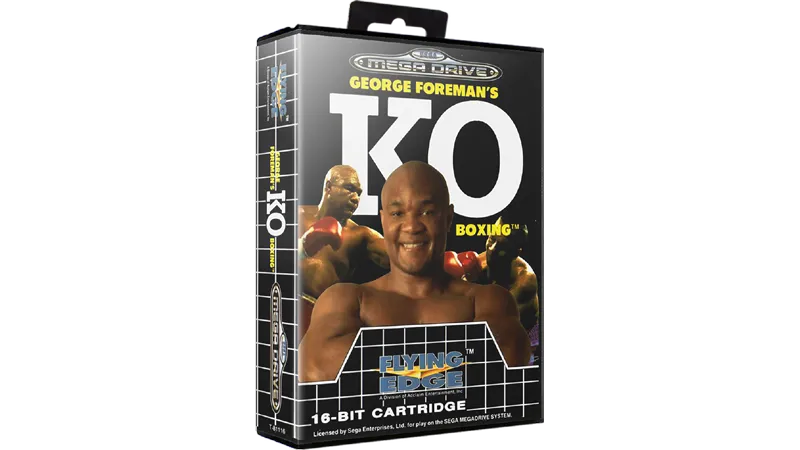



George Foreman’s KO Boxing arrived on the Mega Drive during the peak of the legendary heavyweight’s improbable career comeback, attempting to translate his "power over speed" philosophy into 16-bit code. Visually, the game makes a strong first impression with large, detailed sprites that dominate the screen, providing a sense of scale and presence that many contemporary sports titles lacked at the time. The presentation mimics a televised broadcast, featuring ring walks and an active referee, yet this aesthetic ambition is immediately hampered by a frame rate that struggles to keep pace with the action, resulting in a flickery and often stuttering visual experience.
The gameplay is defined by a deliberate, almost glacial pacing that forces players to manage a stamina meter with frustratingly high precision. Unlike the fluid movement and snappy response found in Sega’s own boxing titles, Foreman’s outing feels remarkably heavy; punches take significant time to wind up, and the hit detection often feels inconsistent during the heat of a clinch. While the inclusion of a "super punch" mechanic provides some tactical depth, the repetitive AI patterns and limited move set mean that most bouts quickly devolve into a tedious war of attrition rather than a display of the "Sweet Science."
When stacked against the broader 16-bit library, this title serves as a reminder of how branding often took precedence over mechanical polish during the early nineties. It lacks the arcade-style charm of its Nintendo rivals and the technical competence of Electronic Arts' offerings, leaving it as a curiosity for Foreman completionists rather than a must-play for sports fans. Interestingly, while the publisher Acclaim was prolific in localising titles across regions—much like the puzzle game *Zoop*, which was released in the UK and Europe in 1995 but notably never saw a release in Japan for this console—this boxing title remains a clunky relic of a bygone era of licensed sports software.