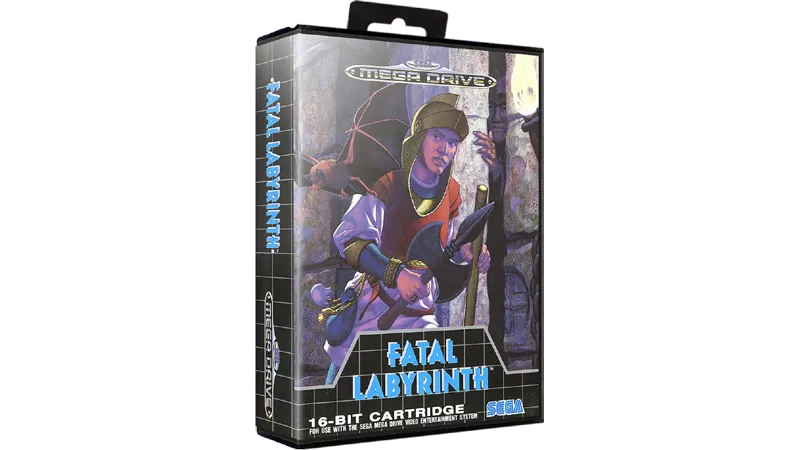



Fatal Labyrinth stands as one of the earliest and purest examples of a "roguelike" on home consoles, predating the genre's modern explosion by decades. As the hero Tryon, players must ascend a randomly generated 30-floor tower to reclaim a stolen holy goblet from a powerful dragon. Every move you make counts as a turn, with enemies reacting simultaneously to your positioning, creating a tactical dance that rewards patience over twitch reflexes. While the premise is rudimentary, the constant tension of exploring the fog of war ensures that no two runs feel exactly the same, providing a level of replayability rarely seen in 1991.
The game’s defining—and often frustrating—mechanic is its unique hunger system. Unlike most RPGs where food simply restores health, overeating in Fatal Labyrinth can lead to a literal "food coma," slowing your movement and leaving you vulnerable to the tower’s denizens. This balances alongside a gear-heavy progression system where weapons and armor are found in chests, but their magical properties remain hidden until they are equipped or identified. It creates a constant gamble: do you risk wearing a potentially cursed suit of plate mail to survive a difficult floor, or do you play it safe and risk being overwhelmed by the rapidly scaling difficulty of the monsters?
Visually and aurally, the title is undeniably sparse, reflecting its origins as a Sega Meganet download service title in Japan before its physical cartridge release. The tile sets are repetitive, and the soundtrack consists of a few looping themes that may grate on the nerves during longer sessions. However, there is a hypnotic quality to its simplicity that remains compelling for genre enthusiasts who value mechanics over window dressing. It lacks the narrative depth of its contemporary, Shining in the Darkness, but for those seeking a pure, unadulterated dungeon crawl on the Mega Drive, it remains a fascinating and punishing relic of 16-bit history.