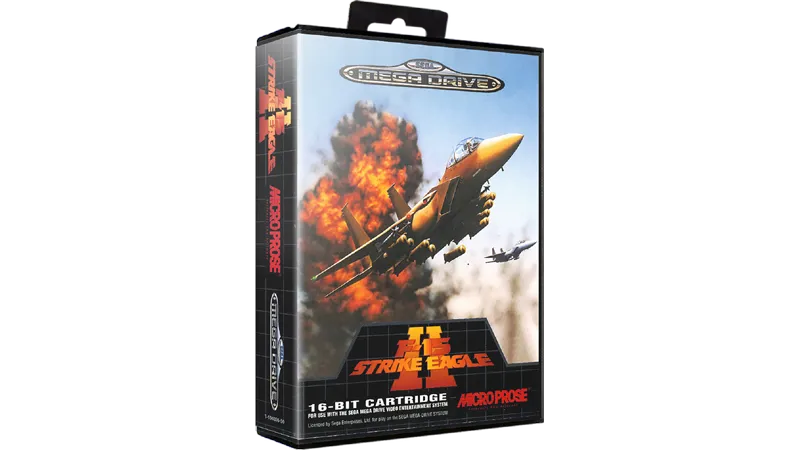



MicroProse’s F-15 Strike Eagle II arrived on the Mega Drive as a technical showcase, attempting to translate complex PC flight simulation into a console-friendly format. While the 16-bit hardware was never designed for heavy 3D math, the developers managed to squeeze a functional polygonal engine out of the machine, offering a surprisingly fast-paced aerial combat experience. The visual presentation is stark, dominated by flat-shaded polygons and a minimalist cockpit, yet it successfully captures the scale of the Middle Eastern and European theaters. It represents a bold step away from the sprite-scaling "Super Burn-Out" style visuals typical of the era, leaning instead into true three-dimensional movement that was rare for the system.
Gameplay strikes a fine balance between a hardcore simulation and an accessible arcade dogfighter. Players must manage their radar, toggle between heat-seeking Sidewinders and long-range Sparrows, and monitor fuel consumption while engaging enemy MiGs across multiple mission profiles. The frame rate is arguably the game’s greatest enemy, often dipping during intense low-altitude skirmishes or when multiple ground targets are on screen, which can make precision bombing runs a frustrating exercise. However, the control scheme is intelligently mapped to the standard three-button pad, ensuring that console players aren't overwhelmed by the complex avionics usually found in the series' PC counterparts.
By the time the Mega Drive neared the end of its commercial lifespan in 1995, the library had diversified into experimental puzzles and late-gen ports. While games like the puzzle-hit Zoop were reaching UK and European shelves in 1995 to provide quirky polygon-adjacent action—notably skipping a Japanese release on the console entirely—F-15 Strike Eagle II remained a pillar of the system's "serious" software library. It remains a testament to MicroProse’s engineering prowess, proving that even without a dedicated DSP chip, the Mega Drive could provide a convincing, if choppy, window into the world of modern aerial warfare.