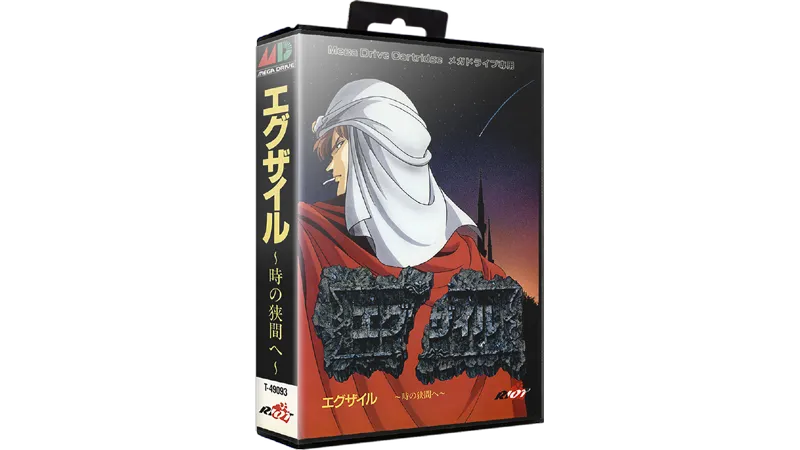

Exile (originally titled XZR II in Japan) is one of the Mega Drive’s most distinct, albeit polarizing, action-RPGs. Developed by Telenet Japan, it follows the journey of the desert assassin Sadler as he traverses various historical eras and religious landscapes in a quest to reshape the world. The gameplay splits its time between top-down town exploration—where the story is advanced through dialogue—and side-scrolling action sequences. While the narrative ambition is commendable, the actual combat feels somewhat stiff compared to contemporaries like Strider or Shinobi, often suffering from awkward hitboxes and repetitive enemy patterns that can frustrate those looking for tight arcade precision.
The Western localization by Renovation Products is infamous for its extensive "sanitization" of the original script. In its original Japanese form, the game was a provocative critique of organized religion and featured a mechanic where the protagonist used narcotics—such as morphine and hashish—to boost his stats. To navigate the strict content policies of the early 90s, the US version scrubbed references to Islam and Christianity and replaced drug use with generic items like "burning sand" or "heart medicine." Despite this hacking of the script, the core of the experience remains a surreal, dark odyssey that feels significantly more mature and experimental than the standard "save the kingdom" tropes typical of the era.
Visually, Exile showcases the classic Telenet style, prioritizing large, cinematic cutscenes and atmospheric music over fluid sprite animation. The character sprites are relatively small and the backgrounds in the action stages can be sparse, yet the game manages to evoke a haunting atmosphere through its moody FM synthesis soundtrack. It is an acquired taste that rewards patient players who value world-building and historical curiosity over refined gameplay mechanics. It stands as a fascinating relic of a time when developers were pushing the boundaries of storytelling on home consoles, even if the hardware and censors weren't always ready for it.