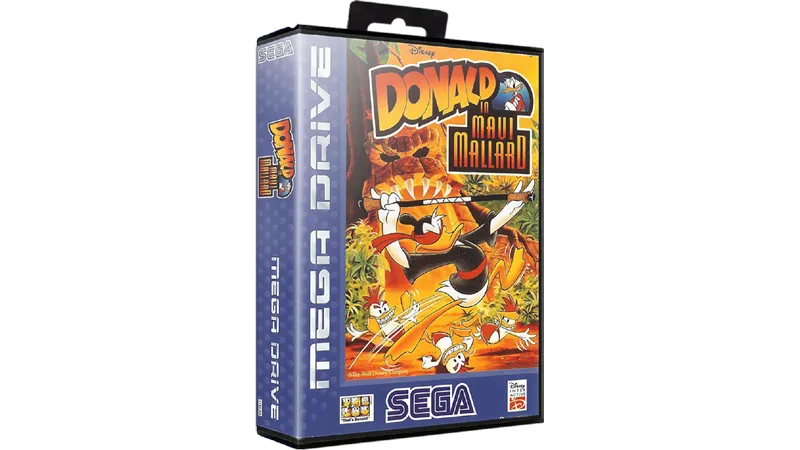



Donald in Maui Mallard represents one of the most ambitious departures for Disney’s flagship duck, pivoting away from the whimsical globe-trotting of QuackShot into a moody, pulp-noir atmosphere. Stepping into the role of a Hawaiian-shirt-clad detective who can transform into a lethal ninja named Cold Shadow, the game offers a sophisticated take on the 16-bit platformer. The animation is nothing short of spectacular, featuring fluid, expressive sprites and a dark, neon-tinged color palette that pushes the Mega Drive’s hardware to its limits, creating an experience that feels more like an interactive cartoon than a standard video game.
The gameplay centers on the duality between Maui’s bug-collecting pistol and Cold Shadow’s acrobatic staff combat. This transition between ranged detective work and high-speed martial arts provides a varied pace, though the difficulty is notably higher than contemporary Disney titles. Level designs are intricate, often requiring precise grappling and frame-perfect jumps, particularly in the later stages. While the controls are generally responsive, the sheer speed of the ninja segments can occasionally lead to frustrating deaths, demanding a level of mastery that rewards patient players who appreciate technical platforming over casual play.
Technically, the Mega Drive version is a triumph of late-lifecycle development, arriving in late 1995 alongside other niche releases such as Zoop—which, despite being a Western puzzle staple, never saw a release in Japan for this console. The soundtrack is a particular highlight, utilizing the Yamaha FM chip to produce tribal, driving rhythms that perfectly complement the mysterious island setting. Although it arrived as the 32-bit era was beginning to overshadow the Mega Drive, Maui Mallard stands as a testament to the peak of 2D craftsmanship, offering a deep and atmospheric swan song for Disney on the platform.