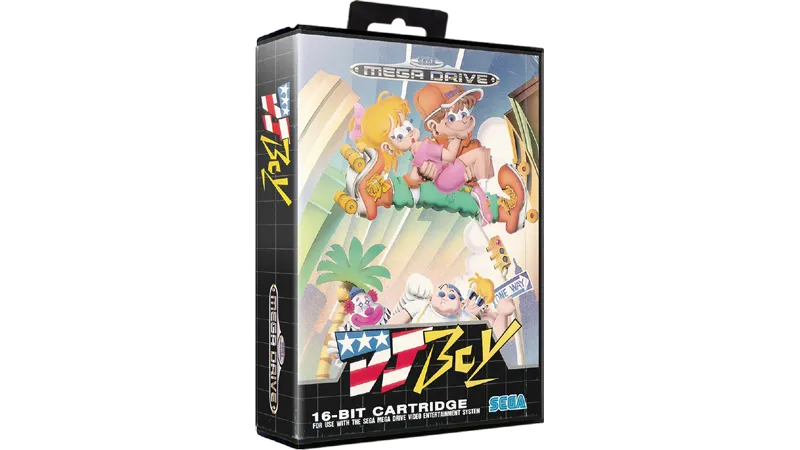


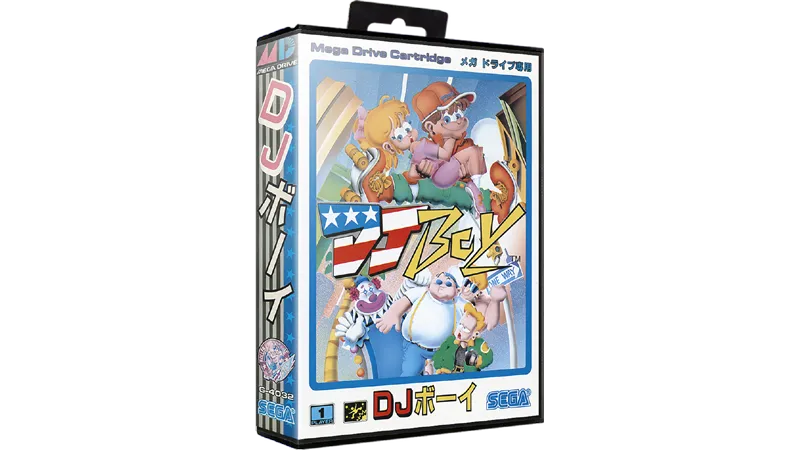

DJ Boy rolled onto the Mega Drive in 1990, attempting to capitalize on the burgeoning hip-hop culture and the roller-skating craze of the era. Developed by Kaneko, it stands as a unique curiosity in the side-scrolling beat 'em up genre, primarily because your protagonist navigates the mean streets of "Coney Island" exclusively on wheels. While the arcade original boasted vibrant sprites and a certain irreverent charm, the home port struggles to maintain that energy, translating into a flicker-heavy experience that feels significantly scaled back in terms of visual flair and audio fidelity.
The transition to the 16-bit console highlighted deep mechanical flaws that were perhaps easier to overlook in a noisy arcade setting. Combat lacks the satisfying impact found in contemporaries like Streets of Rage, as the skating physics make precise positioning a frustrating chore rather than a tactical advantage. Hit detection is notoriously finicky, and the enemy variety is lacking, often forcing the player to rely on repetitive jump-kicks to survive the onslaught of bizarre foes. While the shop system—allowing for performance upgrades and health refills between rounds—adds a minor layer of strategy, it isn't enough to compensate for the stiff animations and the overall sluggish pace of the encounters.
Historically, DJ Boy is most notable for its drastic localization changes and eccentric boss encounters, including the infamous "Big Mama." The Western Mega Drive release saw significant censorship of various "urban" caricatures and sprites compared to the Japanese version to avoid controversy. It serves as a stark reminder of early 90s localization sensitivities, contrasting sharply with later, more standardized international releases like Zoop, which arrived in 1995 for UK and European audiences but never saw a Japanese Mega Drive debut. Ultimately, DJ Boy remains a kitschy relic of its time: high on concept but unfortunately low on the mechanical execution required to compete with the genre's heavyweights.