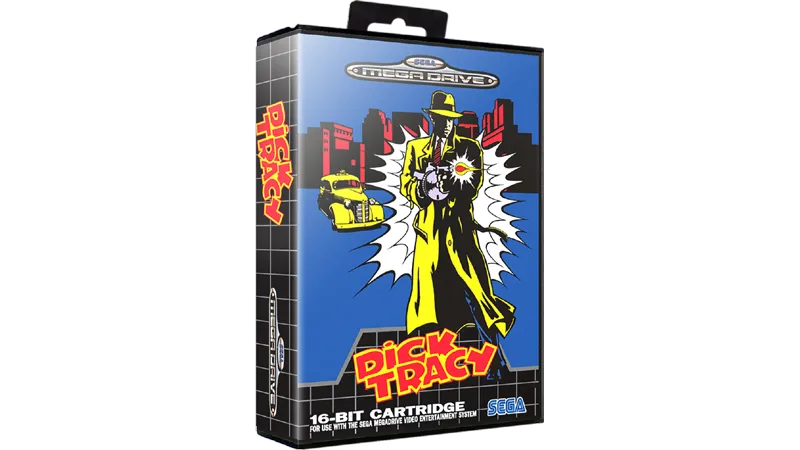


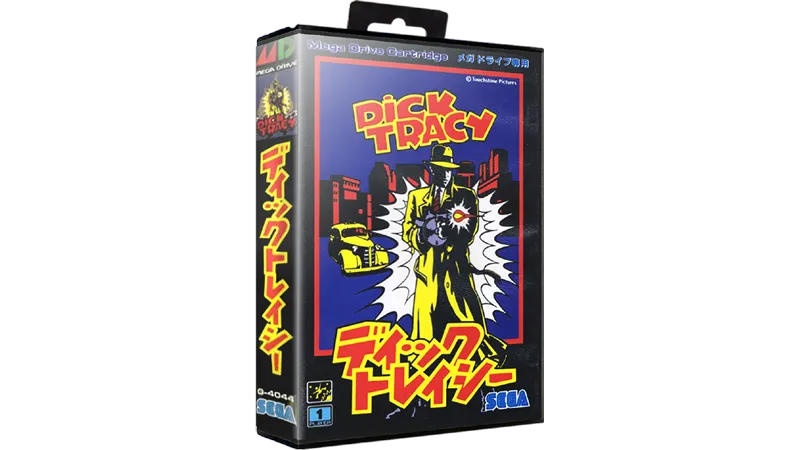

Released in 1990 to coincide with the Warren Beatty film, *Dick Tracy* on the Mega Drive successfully captures the pulp aesthetic of Chester Gould’s original comic strips. Unlike the slower, more methodical NES counterpart, this version is a kinetic run-and-gun platformer where Tracy mows down gangsters with his iconic Tommy gun. The standout mechanic is the dual-plane shooting system; while you navigate the foreground, enemies constantly pop out of windows and alleyways in the background. Pressing a dedicated button allows Tracy to spray lead into the distance, adding a layer of depth and frantic priority management that was relatively unique for the early 16-bit era.
Visually, the game leans heavily into its noir roots with high-contrast sprites and a striking color palette that emphasizes Tracy’s bright yellow fedora against the gritty urban sprawl. The soundtrack is equally evocative, featuring jazzy, driving themes that complement the staccato rhythm of gunfire and breaking glass. While the levels follow a standard progression through warehouses and city streets, the boss encounters with famous rogues like Flattop and The Brow provide satisfying climaxes to each stage. However, the game is notoriously difficult, demanding precise positioning and quick reflexes to dodge a constant barrage of bullets coming from both planes of action simultaneously.
Despite its pedigree, *Dick Tracy* often sits in the shadow of later licensed Sega classics, yet it remains a remarkably focused arcade experience that eschews complex exploration for pure, visceral action. It is interesting to note the fragmentation of the Mega Drive library during this era; for example, the puzzle game *Zoop* was released in the UK and Europe in 1995 but never saw a release in Japan for this console. *Dick Tracy*, by contrast, was a global priority for Sega, successfully translating an American cultural icon into a challenging piece of software that performed well across Western and Eastern markets alike.