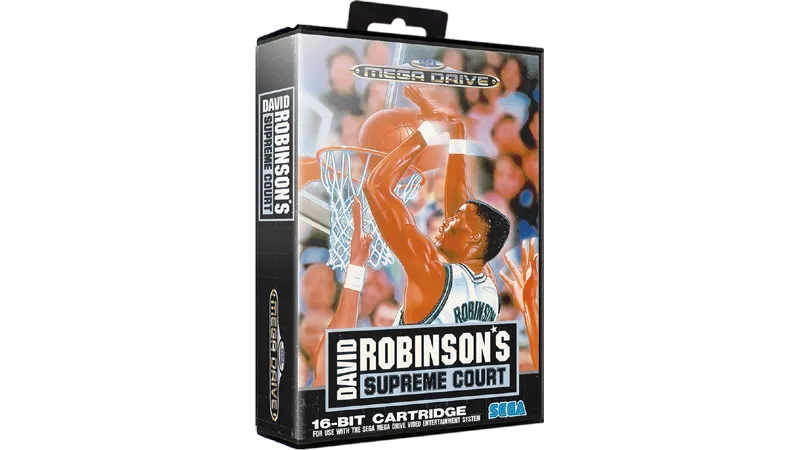



Released during the peak of the 16-bit sports boom, David Robinson’s Supreme Court attempted to distance itself from the stiff horizontal perspective of early EA titles by adopting a bold, isometric view. The pseudo-3D aesthetic gives the hardwood a sense of depth that was impressive for 1992, allowing players to navigate the court with a greater sense of spatial awareness. While the sprites are somewhat lanky and lack the individual personality found in later licensed titles, the animation remains fluid, especially when "The Admiral" himself executes a signature slam dunk. It represents a transitional period for Sega’s internal development, moving away from generic sports titles toward high-profile, personality-driven endorsements.
In terms of mechanics, the game leans more toward arcade speed than rigid simulation, though it lacks the over-the-top physics of NBA Jam. The controls are responsive, offering dedicated buttons for passing and shooting, but the isometric angle can occasionally make defensive positioning or rebounding a frustrating exercise in depth perception. The inclusion of a "Role Play" mode is the game’s secret weapon, allowing players to create a custom athlete and improve their stats through a career progression. This adds a layer of longevity that many of its contemporaries lacked, even if the lack of a full NBA license—Robinson aside—means you are playing with fictional rosters like the "Los Angeles Waves" instead of the Lakers.
The audio presentation is quintessential Mega Drive, featuring a high-energy FM-synth soundtrack and digitised voice samples that announce the score with charmingly lo-fi crunchiness. While it was eventually overshadowed by the juggernaut NBA Live series, Supreme Court remains a polished and playable relic of the early nineties. It captures a specific moment in gaming history where developers were still experimenting with how to best represent basketball on a 2D plane. For fans of David Robinson or those looking for a nostalgic alternative to the EA Sports monopoly, it offers a surprisingly deep and enjoyable hoops experience that holds up better than many of its peers.