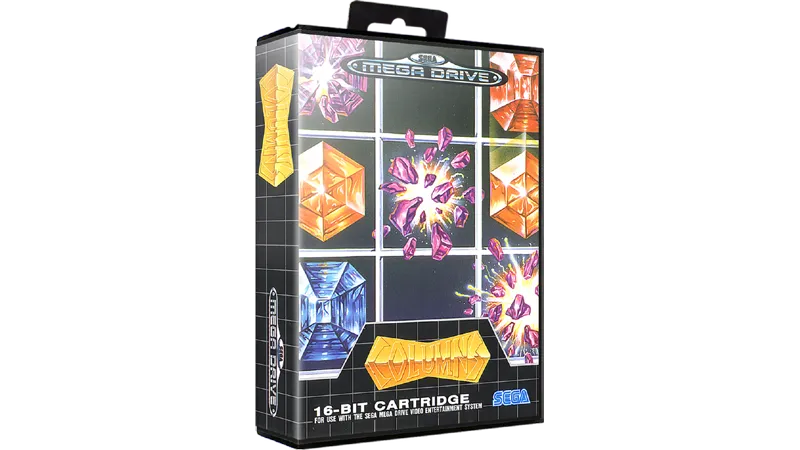


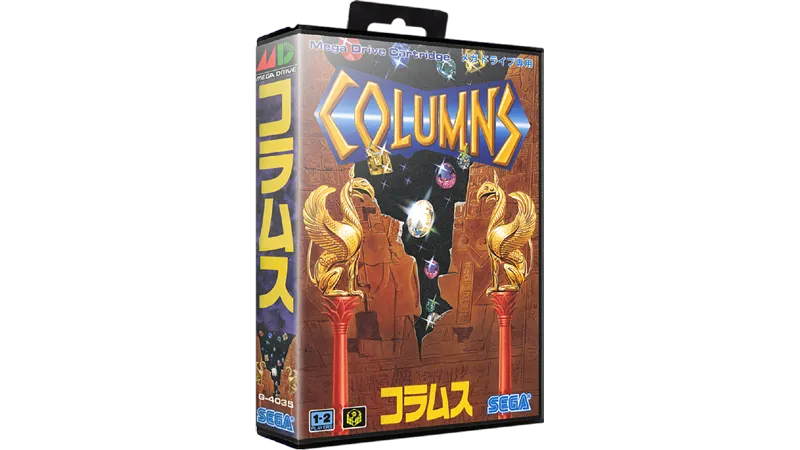

Released in 1990 as a direct response to the runaway success of Tetris on Nintendo platforms, Columns quickly became the definitive puzzle experience for the Sega Mega Drive. Moving away from the industrial aesthetic of its rival, Sega opted for an elegant, ancient civilization theme, replacing geometric blocks with glittering jewels. The core loop is deceptively simple: players manage falling vertical stacks of three colored jewels, shifting the internal order of the gems as they drop to create matches of three or more horizontally, vertically, or diagonally.
What distinguishes Columns from other falling-block puzzlers is its heavy emphasis on the "cascade" effect. Because matches cause gems above to drop into the vacant spaces, skilled players can set up complex chain reactions that offer massive point multipliers and clear the board in a satisfying rush of sound and light. While it lacks the tactical rotation mechanics found in its peers, it replaces them with a frantic necessity for color recognition and rapid spatial planning. The difficulty curve is masterfully tuned, transitioning from a zen-like flow into a high-speed test of reflexes as the iconic "Clotho" music track accelerates.
The game remains a cornerstone of the 16-bit era, largely due to its inclusion in the "Mega Games" bundles which made it one of the most widely owned titles on the system. Its visual presentation is timeless, featuring glittering jewel sprites and evocative backgrounds that still look sharp on original CRT hardware. While later entries in the genre would introduce more complex gimmicks, the original Columns stands as a masterclass in pure, addictive gameplay. It is an essential component of any Sega collection and a reminder that Sega’s arcade DNA was just as potent in the puzzle genre as it was in action gaming.