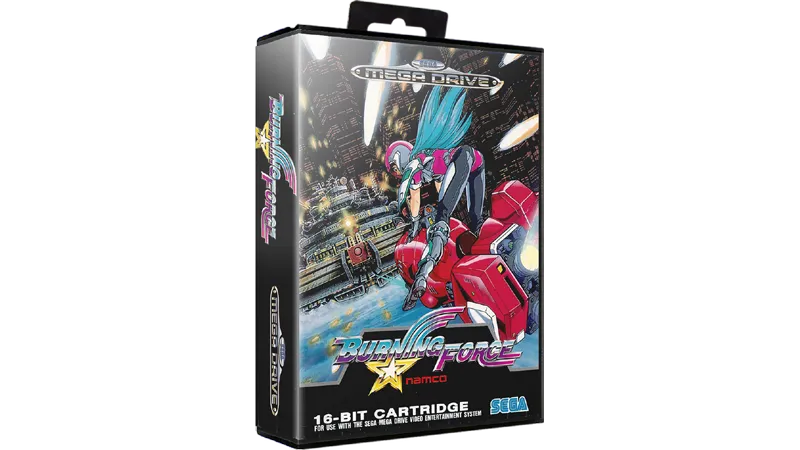


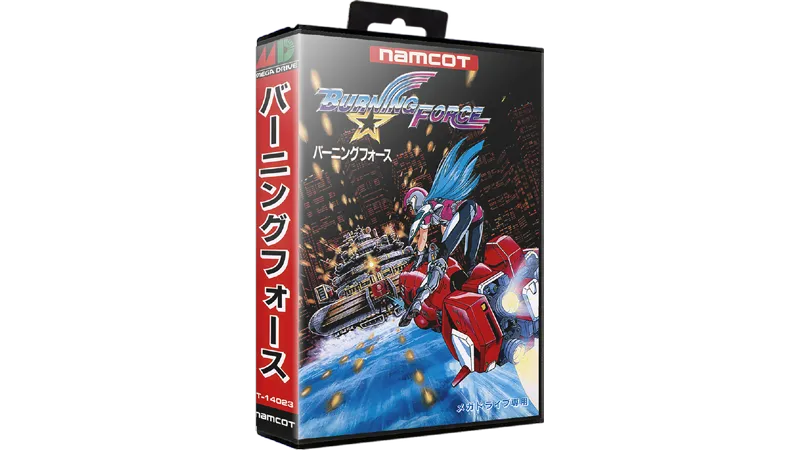

Namco’s Burning Force arrived on the Mega Drive in 1990 as a vibrant, colorful conversion of their 1989 arcade hit. Casting players as cadet Hiromi Tengenji, the game follows her final six-day graduation exam at the Earth Academy. While it clearly takes inspiration from Sega’s Space Harrier, it carves out its own identity through its structured "day" system and a distinct sci-fi aesthetic that feels more grounded than its surreal contemporaries. The transition from the arcade’s System 2 hardware to the 16-bit console is remarkably handled, maintaining the fast-paced forward-scrolling momentum that defined the experience.
The gameplay loop is satisfyingly rhythmic, divided into four areas per day that culminate in challenging boss encounters. Players spend the first two areas on an air-bike, dodging ground-based hazards and weaving through airborne enemies, before the vehicle transforms into a jet for the final stretches. This shift in perspective and handling keeps the action from becoming stale, as the jet sections offer greater verticality and a different sense of speed. Power-ups like wide beams and heat-seeking missiles provide necessary tactical depth, especially when the screen becomes cluttered with projectile fire during the later, more frantic stages.
Visually, Burning Force is a showcase of clever programming, utilizing sprite scaling and layering to simulate a three-dimensional field without the aid of specialized chips. The color palette is exceptionally bright for the Mega Drive, capturing the "blue sky" arcade era of the late 80s perfectly. While the difficulty spikes significantly in the final two days, the tight controls and upbeat FM-synth soundtrack encourage repeated playthroughs. It remains one of the most polished rail shooters on the platform, proving that Namco could rival Sega’s own home-turf arcade ports with ease.