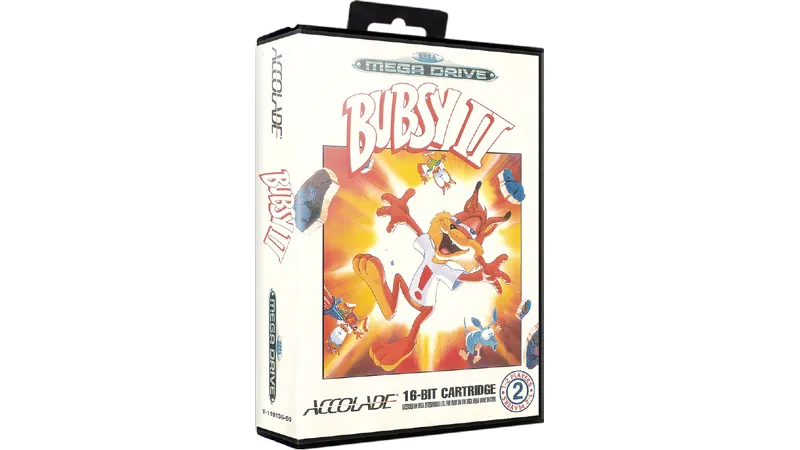



Bubsy II arrived on the Mega Drive in 1994, attempting to refine the "fast-and-fragile" mascot platforming that defined the original. Developed by Accolade, the sequel moves away from linear progression, opting instead for the "Amazatorium," a central hub allowing players to tackle five distinct themed wings in any order. While the core loop remains centered on collecting marbles and dodging hazards, the addition of mini-games and a two-player mode involving Bubsy’s niece and nephew, Arnold and Terry, tried to inject more variety into a franchise struggling to find a solid mechanical identity.
Mechanically, the game introduces a much-needed health system; unlike the "one-hit-death" brutality of the first title, Bubsy can now survive several collisions before losing a life. To aid his survival, he is equipped with a range of gadgets, including a portable hole for teleportation and a Nerf-style ballzooka for ranged combat. Visually, the Mega Drive version maintains the vibrant, Saturday-morning cartoon aesthetic of its predecessor, but the levels often feel cluttered, with background elements occasionally obscuring dangerous projectiles or enemy sprites, leading to a sense of visual exhaustion.
Despite these functional improvements, Bubsy II fails to fix the series' most glaring issue: the loose, "ice-skating" physics of the protagonist. Navigating the sprawling, vertical levels remains a frustrating exercise in momentum management, as the camera often struggles to keep up with Bubsy’s erratic speed. While it is arguably a more polished and accessible package than the first game, it lacks the tightly tuned level design required to compete with the 16-bit era’s heavyweights like Sonic or Mario, leaving it as a middling curiosity for platforming completionists.