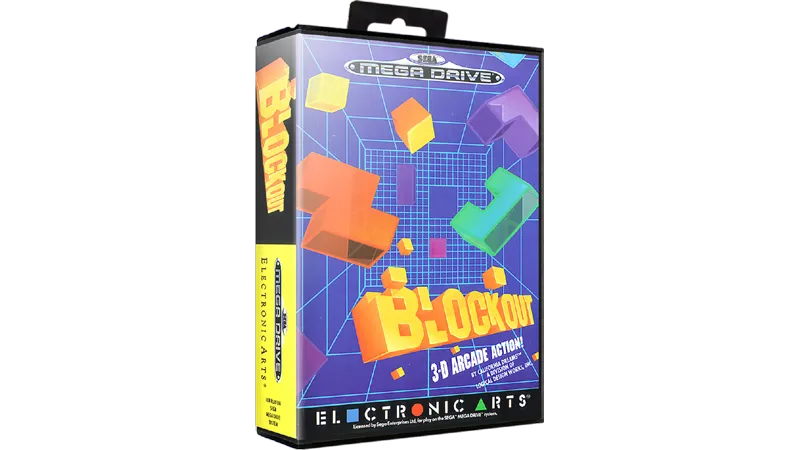


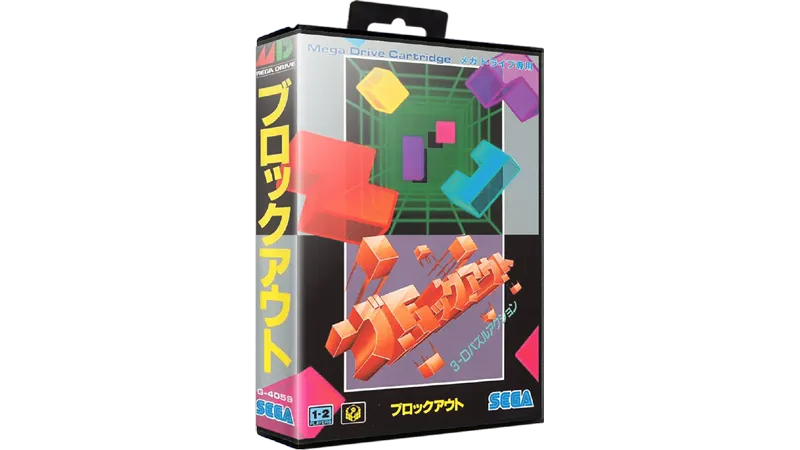

Blockout takes the familiar addictive formula of Tetris and adds a daunting third dimension, tasking players with filling a wireframe pit from a top-down perspective. Developed by California Dreams and published by Electronic Arts, this conversion captures the clinical, cerebral nature of the arcade original, requiring players to manipulate complex polyominoes across three axes of rotation. While the concept sounds simple, the spatial awareness required to visualize where a piece will land at the bottom of the "well" provides a significant jump in difficulty compared to its 2D cousins. It is a game of mental geometry that transforms the screen into a deep, translucent void where every mistake creates a hollow gap that is notoriously difficult to rectify.
On the Mega Drive, the presentation is functional and focused, utilizing clean lines and a smooth frame rate to ensure the 3D effect remains legible even as the pit fills up. The control scheme is the biggest hurdle, as players must juggle multiple buttons to flip blocks along different planes, but once the muscle memory settles, the game becomes incredibly meditative. By the mid-90s, the puzzle genre on the console had shifted toward more colorful, mascot-driven titles like Zoop—which famously reached UK shores in 1995 but bypassed the Japanese Mega Drive market entirely—making Blockout feel like a more mature, architectural relic of early 16-bit software. The sound design is minimalist, but the satisfying "clonk" of a seated piece provides the necessary feedback for a game that relies entirely on precision and spatial logic.
Ultimately, Blockout is a rewarding experience for those who find standard line-clearing games too linear, offering a customizable experience where you can alter the pit dimensions and block complexity. It lacks the immediate "pick up and play" charm of its contemporaries, but the depth of strategy involved in layer management is unmatched on the hardware. It remains a fascinating technical curiosity that proves the Mega Drive could handle complex spatial geometry without the need for specialized chips, standing as the definitive 16-bit home version of this cult classic. For players who enjoy the feeling of their brain being physically stretched, this is a must-own addition to the puzzle collection.