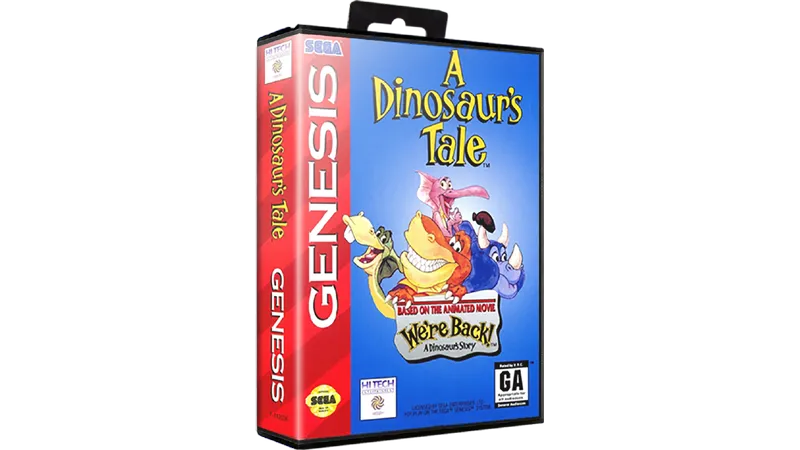


Published by Hi Tech Expressions and developed by the then-fledgling Funcom, *A Dinosaur’s Tale* attempts to translate the whimsical charm of the Spielberg-produced Amblimation film into a 16-bit platformer. Visually, the game captures the vibrant, Saturday-morning cartoon aesthetic reasonably well, utilizing a bright color palette that stands out on the Mega Drive hardware. The character sprites for Rex and his prehistoric companions are sizeable and well-animated, though the level backgrounds occasionally feel sparse and repetitive. It remains a quintessential example of a mid-90s licensed tie-in: technically competent but lacking the visual polish of contemporary Disney offerings like *Aladdin* or *The Lion King*.
Mechanics-wise, the game relies on a standard hop-and-bop foundation, supplemented by a unique buddy system where the human characters, Louie and Cecilia, provide assist items to help the dinosaurs navigate levels. While the controls are responsive enough for basic navigation, the hit detection can be frustratingly inconsistent, particularly during boss encounters or tight platforming sections in the Central Park levels. The difficulty curve is surprisingly steep for a title aimed at younger audiences, often relying on "leap of faith" jumps and obscured enemy placements to pad out the short playtime. It is a serviceable experience, but one that fails to innovate beyond the genre’s established tropes.
The audio presentation is perhaps the game's weakest link, featuring a soundtrack that, while catchy in short bursts, becomes grating due to short loops and high-pitched synth choices that fail to utilize the Yamaha YM2612 chip effectively. Compared to the sweeping orchestral score of the motion picture, the Mega Drive’s FM synthesis feels somewhat wasted here, resulting in a tinny soundscape. In the broader library of the console, *A Dinosaur’s Tale* remains a nostalgic curiosity rather than a hidden gem—a relic of an era when every animated feature demanded a cartridge regardless of its mechanical depth. While it lacks the refinement of a Sega-produced title, it serves as a competent, if unremarkable, piece of licensed history.