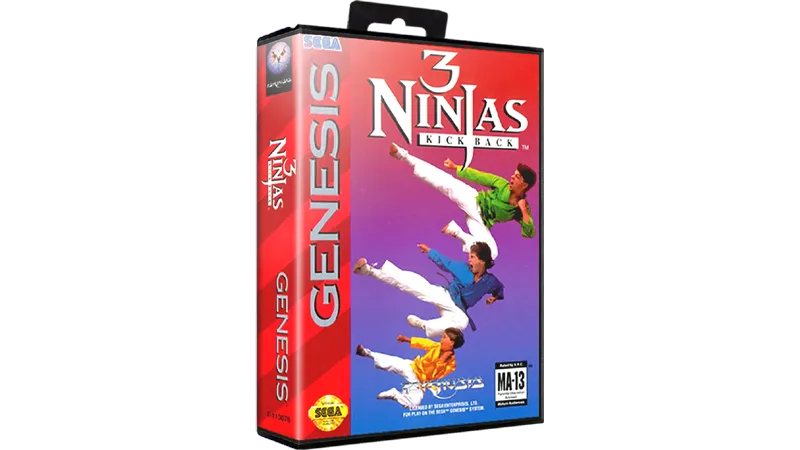


Released during the twilight years of the 16-bit era, 3 Ninjas Kick Back serves as a quintessential example of the licensed platformer boom of the mid-90s. Developed by Malibu Interactive, the title follows the plot of the second film in the franchise, tasking the three brothers—Rocky, Colt, and Tum-Tum—with retrieving a sacred dagger in Japan. While the Sega CD version famously includes FMV sequences from the movie, the Mega Drive cartridge relies on its vibrant sprite work to convey the martial arts adventure. It sits within a late-life library that saw titles like the puzzle-game Zoop arriving in the UK and Europe as late as 1995, though notably, neither Zoop nor 3 Ninjas Kick Back received a release on the Japanese Mega Drive.
Gameplay allows players to select between the three brothers, each wielding their signature weapons: the bo staff, katana, and sai. While the character sprites are reasonably well-animated, the controls often feel sluggish, lacking the surgical precision found in genre giants like Shinobi III. The level design spans forests, hospitals, and traditional Japanese castles, but the platforming is frequently marred by awkward hit detection and repetitive enemy encounters. It captures the Saturday-morning energy of the film franchise, yet it fails to provide the mechanical depth required to make the combat feel truly satisfying or distinct from dozens of other movie tie-ins of the period.
Despite its mechanical shortcomings, the game remains a significant piece of history for collectors of late-generation software. Its release timing meant it was overshadowed by the looming 32-bit revolution of the Saturn and PlayStation, resulting in lower sales figures than earlier platformers. Visually, the Mega Drive version struggles with a muddy color palette compared to its Super Nintendo counterpart, though the FM synthesis sound chip delivers some punchy, if forgettable, action tracks. Ultimately, it is a functional but uninspired platformer that relies heavily on its license, appealing more to nostalgia-driven collectors than those seeking a refined action experience.