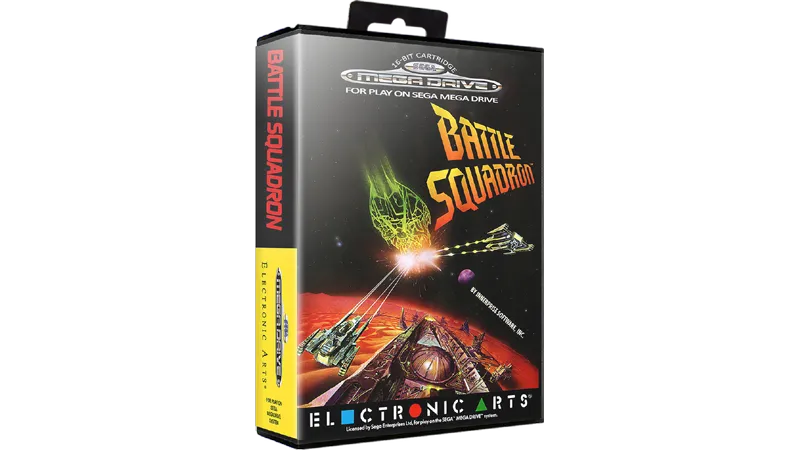



Battle Squadron stands as a premier example of the Amiga-to-Mega Drive pipeline, showcasing the technical prowess of Danish developer Cope-com. Originally a flagship title for Commodore’s 16-bit machine, this vertical scrolling shoot-'em-up successfully transitioned to Sega’s hardware in 1990, retaining its signature moody atmosphere and frantic pace. Players take control of the FX-32 Soul-Slayer, tasked with dismantling the alien Barraxian Empire across various hostile environments. It distinguishes itself from the arcade-heavy library of the Mega Drive by offering a distinctly European aesthetic, blending organic and mechanical designs in a way that felt fresh compared to the neon-soaked Japanese shooters of the era.
The gameplay loop is defined by its deep weapon system and the innovative "cloaking" mechanic, which allows players to briefly vanish from the screen to avoid incoming fire. While most shooters of the era focused on raw firepower, Battle Squadron requires strategic use of the Nova Bomb and precise navigation through dense bullet patterns. The weapon variety—ranging from the concentrated Emerald Laser to the wide-reaching Red Magma—adds significant replay value, especially in the simultaneous two-player mode. Though the Mega Drive version suffers from a slightly reduced color palette compared to its Amiga progenitor, the inclusion of smooth parallax scrolling and a high-intensity soundtrack ensures the hardware is pushed to its limits.
Decades later, the title remains a cult favorite for its unapologetic difficulty and unique scoring system, which rewards players for efficiency rather than just survival. It lacks the technical polish of a Treasure or Konami production, but it compensates with grit and a sense of scale that few early 16-bit titles managed to capture. The boss encounters are particularly memorable, requiring specific pattern memorization and twitch reflexes. While the genre would eventually evolve toward the "bullet hell" sub-genre, Battle Squadron serves as a vital bridge between classic 8-bit sensibilities and the maximalist design of the mid-90s, making it a mandatory play for any serious Mega Drive enthusiast.