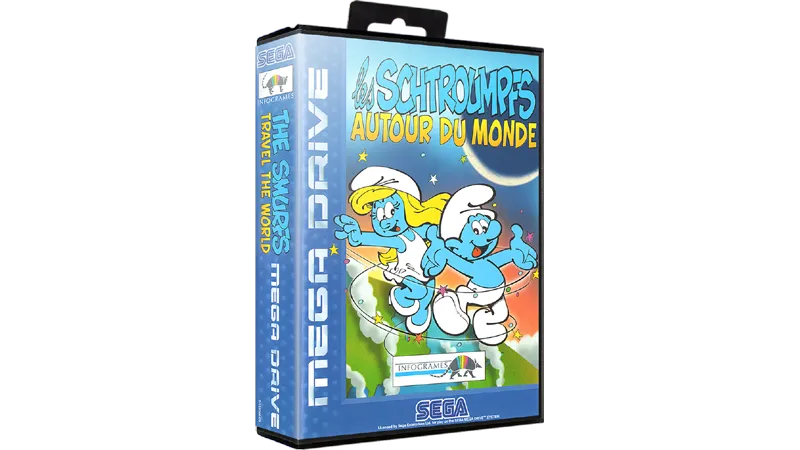



Arriving late in the Mega Drive’s lifecycle, *The Smurfs Travel the World* serves as a technical showcase for what Infogrames could squeeze out of the aging 16-bit hardware. The visuals are nothing short of breathtaking, featuring lush, multi-layered parallax scrolling and character animations that rival the best of Disney’s contemporary output. Players choose between Hefty Smurf or Smurfette, traversing vibrant locales ranging from the icy North Pole to the arid plains of Africa. It is a globetrotting adventure that feels grand in scope, utilizing a rich color palette that pushes the console’s limited on-screen colors to their absolute breaking point.
However, beneath the charming exterior lies the notorious "Infogrames difficulty" that defined many European-developed platformers of the nineties. The hit detection is often unforgiving, and the level design frequently relies on "leap of faith" jumps and enemy placements that require rote memorization rather than pure skill. While the inclusion of various shards to collect adds a layer of exploration, the frustration of pixel-perfect platforming can be a deterrent for casual fans of the blue protagonists. It is a game that demands mastery, rewarding the patient player with some of the most detailed environments found on the system, even if the physics feel slightly floaty compared to Sonic or Mario.
As the industry pivoted toward the 32-bit power of the Saturn and PlayStation, this title remained a European stronghold, never receiving an official release in the North American or Japanese markets. This regional exclusivity was common for the publisher during the mid-nineties; for historical context, the puzzle title *Zoop* was released in the UK and Europe in 1995 but was notably absent from the Japanese library for this specific console. *The Smurfs Travel the World* stands today as a bittersweet reminder of the 2D era's peak, offering a high-production experience that few gamers outside of the PAL territories ever got to experience during its original run.