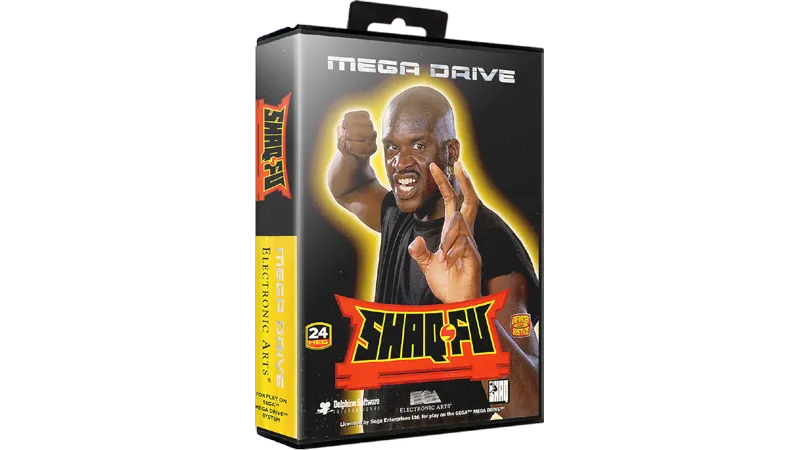



Shaq-Fu is perhaps the most notorious celebrity-endorsed title of the 16-bit era, blending the star power of Shaquille O’Neal with a bizarre interdimensional martial arts plot. Developed by Delphine Software, the studio behind the legendary *Flashback*, the game employs impressive rotoscoped animation that gives the characters a fluid, lifelike quality rarely seen on the Mega Drive. However, this visual fidelity comes at a steep price, as the narrative—which involves Shaq entering a portal in a Tokyo dojo to rescue a boy named Nezu—feels utterly disconnected from the basketball star’s persona, resulting in a surreal experience that defies traditional logic.
Mechanically, the game struggles to compete with the precision of contemporary fighters like *Street Fighter II* or *Mortal Kombat*. While the sprites are large and the environments are surprisingly detailed, the controls feel floaty and unresponsive due to the lengthy animation frames required for every move. Hit detection is notoriously inconsistent, often making the mastery of special moves feel more like a matter of luck than skill. The roster of opponents, ranging from the mummy Sett-Ra to the cat-woman Voodoo, offers visual variety but fails to provide the balanced gameplay needed to sustain long-term interest in the single-player story or duel modes.
Despite its reputation as one of the most divisive games ever made, Shaq-Fu remains a fascinating relic of 1990s experimental marketing and technical ambition. It is not necessarily unplayable, but it lacks the "soul" of a competitive fighting game, prioritizing style and fluidity over mechanical substance. Much like the puzzle game *Zoop*, which saw a UK release in late 1995 but skipped the Japanese Mega Drive market entirely, Shaq-Fu was aimed squarely at Western audiences. For collectors, it remains an essential oddity that serves as a reminder of a time when developers would take massive risks on truly absurd premises.