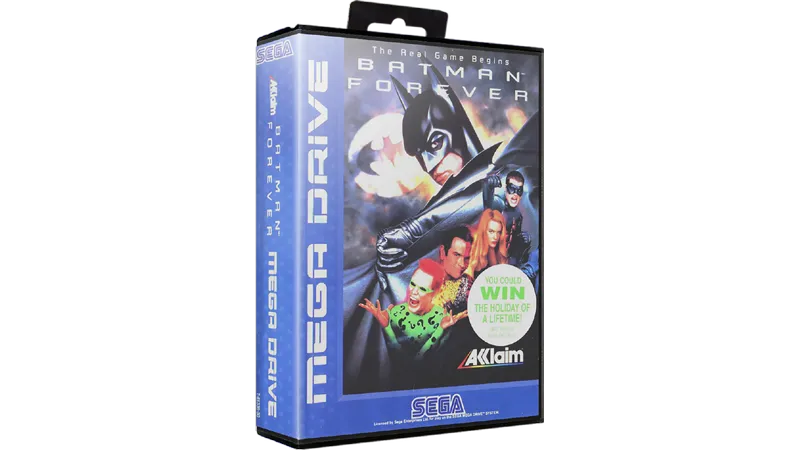


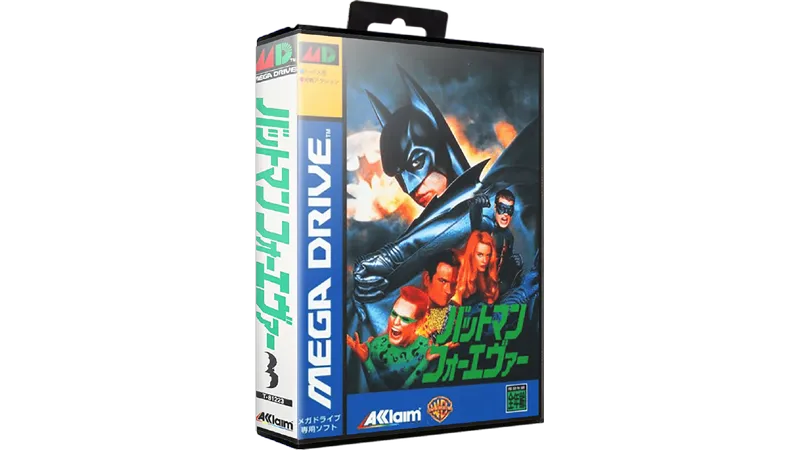

Batman Forever arrived on the Mega Drive in 1995, attempting to replicate the neon-soaked, digitized aesthetic of the Joel Schumacher film. Developed by Probe Entertainment, the game opted for photo-realistic sprites similar to those found in the Mortal Kombat series, which was a bold departure from the traditional pixel art of Sunsoft’s previous Batman titles. While the visuals are moody and atmospheric, successfully capturing the grit of Gotham, the 16-bit hardware often struggles with the color palette, resulting in a murky presentation that frequently lacks the clarity needed for precise platforming.
The core gameplay is where the title truly falters, as it adopts a convoluted control scheme that requires fighting-game-style directional inputs for basic gadgets and movement. Navigating the levels is a chore; grappling to a higher ledge or dropping through a floor feels needlessly complex, often leading to frustrating deaths or aimless wandering through poorly signposted environments. While the combat technically has depth—offering a wide array of bat-gadgets and special moves—the sluggish response times and stiff animations make every encounter feel like a battle against the controller rather than Two-Face’s goons.
Despite its glaring flaws, there is a certain level of ambition in Batman Forever that shouldn’t be entirely dismissed. The inclusion of a cooperative mode and a massive variety of hidden secrets suggest a game that was meant to be mastered over a long period, rather than finished in a single sitting. However, in a year that saw Acclaim pushing various titles across the region—including the puzzle-hit Zoop, which notably bypassed a Japanese Mega Drive release despite its European presence—Batman Forever stands as a testament to the era's obsession with digitized realism over fluid, functional game design.