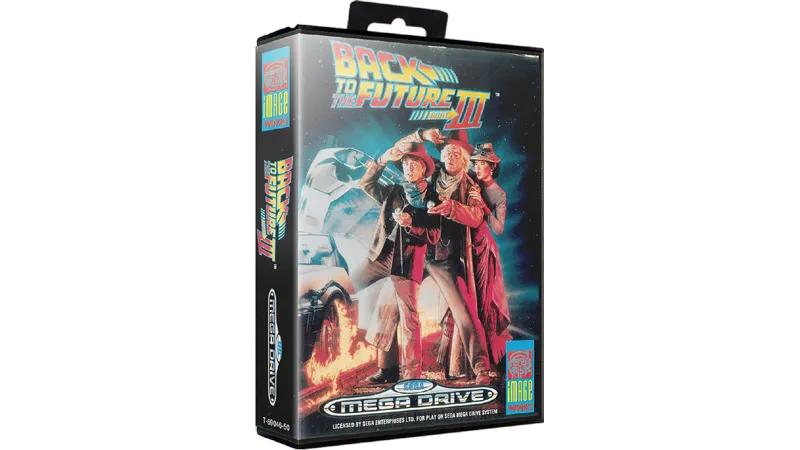



Back to the Future Part III arrived on the Mega Drive in 1991, courtesy of Probe Software, aiming to capture the cinematic thrill of the trilogy’s Wild West conclusion. Unlike the sprawling exploration found in some other movie tie-ins of the era, this 16-bit outing opted for a rigid mini-game compilation structure. Players step into the boots of Marty McFly and Doc Brown across four distinct stages, beginning with a frantic horseback rescue of Clara Clayton. While the transition to the 16-bit hardware allowed for more detailed sprites and recognizable digitized portraits, the game immediately reveals itself as a punishingly difficult experience that relies more on brutal trial and error than genuine skill.
The gameplay loop is divided into four main events: the initial rescue, a target shooting gallery, a pie-throwing brawl, and the final high-stakes climb atop the locomotive. Each stage features vastly different mechanics, yet they are all united by a soul-crushing difficulty curve and stiff controls that often fail to respond in the heat of the moment. The horseback level is particularly notorious for its unrelenting obstacles, requiring pixel-perfect jumps and shots that will frustrate all but the most dedicated fans. This disjointed design prevents any real sense of narrative flow, making the experience feel like a collection of shallow arcade segments rather than a cohesive cinematic adaptation.
Visually, the game is a mixed bag, offering decent color palettes and a fair representation of the 1885 Hill Valley setting, though the animation often feels sluggish compared to other 1991 releases. The soundtrack features a digitized rendition of Alan Silvestri’s iconic theme, which provides a brief surge of nostalgia before looping into repetitive monotony. Ultimately, Back to the Future Part III suffers from the same "movie-tie-in" curse that plagued many titles of the era—rushed production and artificial difficulty used to mask an incredibly short total playtime. It remains a curious piece of history for Sega collectors, but as a piece of software, it fails to reach the 88mph required to be considered a classic.