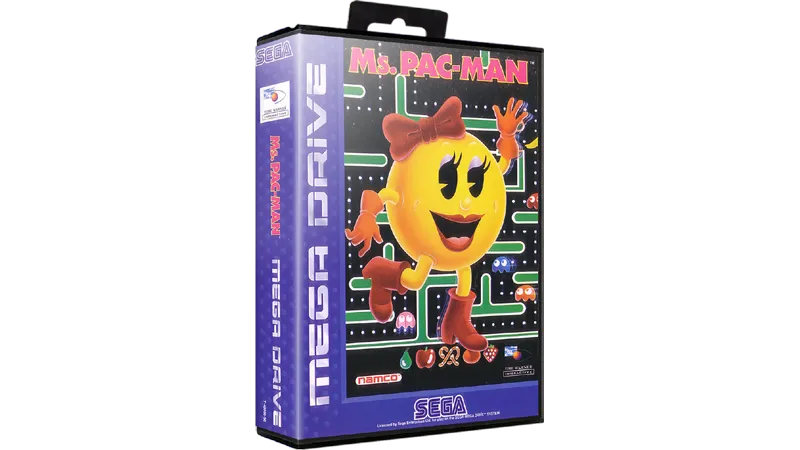
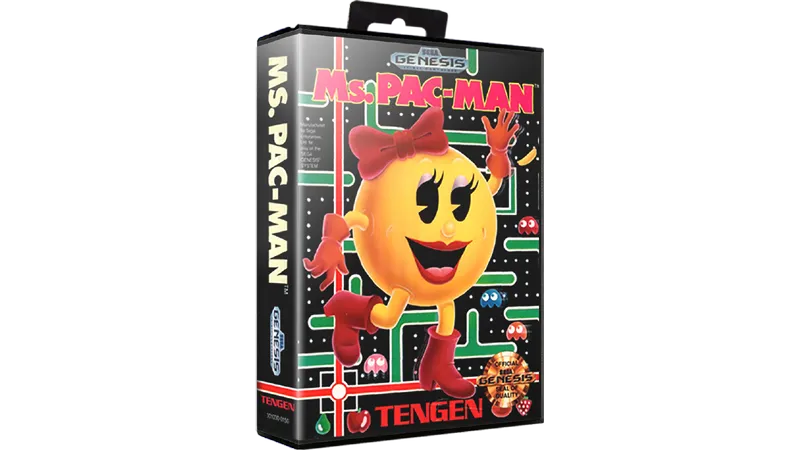



While many arcade ports of the era felt like scaled-back compromises, Tengen’s 16-bit rendition of Ms. Pac-Man stands as one of the most definitive ways to play the classic. Released for the Mega Drive and Genesis during the height of the console wars, this version takes the foundational chase gameplay of the 1982 arcade cabinet and expands upon it with a wealth of customizability. Unlike the earlier, more restrictive ports found on 8-bit hardware, this edition feels remarkably smooth, offering a flicker-free experience that captures the momentum and tension of high-level play with surprising precision.
The true brilliance of this port lies in the variety of modes that go far beyond the original four-maze rotation. Players can choose from "New," "Strange," and "Big" maze categories, totaling 36 unique layouts that range from tight, claustrophobic corridors to massive scrolling boards that challenge your spatial awareness. Furthermore, the inclusion of the "Pac-Booster" toggle—a feature born from unauthorized arcade speed-up hacks—allows for a much faster pace, making the game feel modern and aggressive. The addition of a simultaneous two-player cooperative mode and a competitive point-battle mode adds significant longevity to a title that could have easily been a bare-bones conversion.
Visually and aurally, the game is a faithful recreation that leans into the vibrant, neon aesthetic of the early eighties. While the Mega Drive's sound chip produces slightly grittier versions of the iconic "waka-waka" sound effects and interlude music, the presentation remains charming and polished. For fans of the golden age of arcades, this version of Ms. Pac-Man is an essential library addition that proves why the character often eclipsed her predecessor in terms of design and mechanical depth.