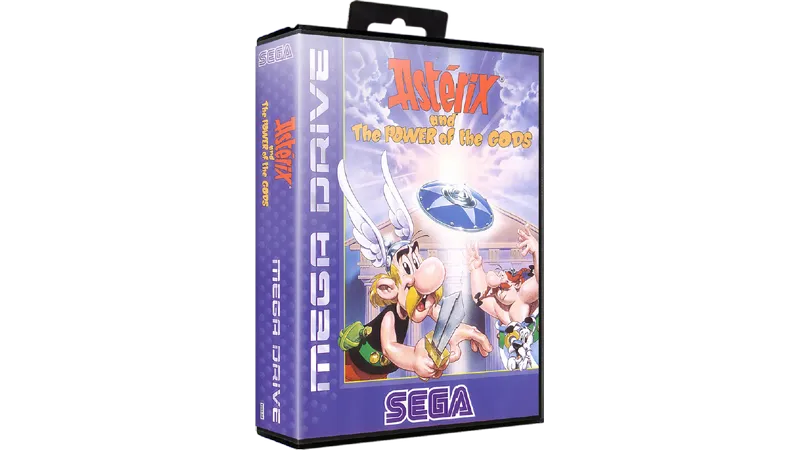



Released during the twilight years of the Mega Drive, Asterix and the Power of the Gods stands as a technical marvel from Core Design. The game captures the aesthetic of the original comics with startling accuracy, featuring large, expressive sprites and vibrant color palettes that push the console's hardware to its limits. Players can choose between the nimble Asterix or the powerhouse Obelix, traversing a non-linear map of the Roman Empire that allows for a surprising amount of exploration and replayability compared to other 16-bit platformers of the era.
The gameplay loop remains a traditional 2D side-scroller at its heart, yet it is distinguished by its sheer variety of environments, ranging from the snowy peaks of Switzerland to the scorching deserts of Egypt. Mechanics are tailored to each character; Asterix relies on speed and Getafix’s magic potions, while Obelix utilizes his raw strength to smash through obstacles and carry menhirs. However, the game is notorious for its steep difficulty curve and occasionally floaty jumping physics, which can lead to frustrating moments during the more precision-heavy segments of the later stages.
Despite these minor control issues, the presentation is bolstered by a fantastic soundtrack and impressive cinematic transitions that make the quest for Caesar’s stolen shield feel truly epic. It serves as a testament to Core Design’s mastery of the 16-bit architecture before they transitioned into the 3D era and achieved global fame with the Tomb Raider series. For fans of the Gallic heroes, this is arguably the most faithful and visually accomplished adaptation of Uderzo and Goscinny’s world on Sega hardware, offering a lengthy challenge for those who have mastered the earlier Master System entries.