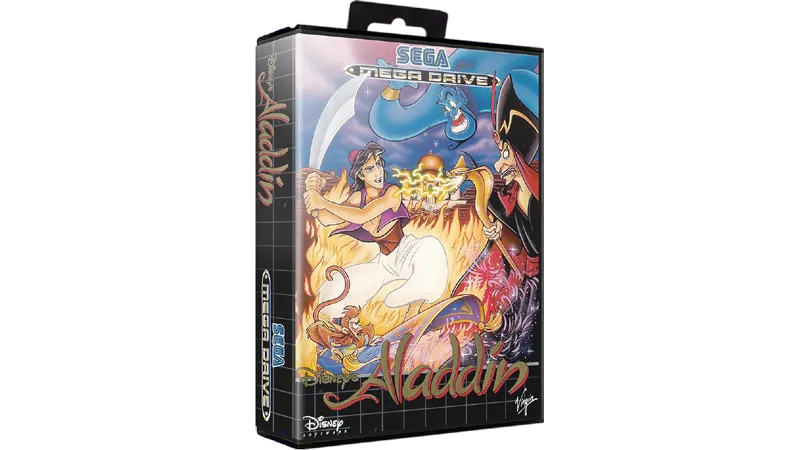



Disney’s Aladdin remains a technical masterclass for the Mega Drive, largely thanks to the revolutionary "Digicel" process developed by Virgin Games. By collaborating directly with Disney’s feature film animators, the developers managed to translate hand-drawn frames into sprite data, resulting in character movement that was fluid and expressive beyond anything previously seen on 16-bit hardware. The vibrant color palette pushes the console’s limited VDP to its absolute limits, making Agrabah feel alive with personality and cinematic flair that rivaled the source material.
Mechanically, the game leans into high-speed action and platforming, arming Aladdin with a scimitar for close encounters and apples for ranged attacks. While the SNES counterpart focused on acrobatics, the Mega Drive version prioritizes combat and momentum through iconic locales like the Cave of Wonders and the Sultan's dungeon. The level design is punctuated by inventive hazards and a difficulty curve that, while occasionally punishing in the later stages, remains consistently engaging. It is an exemplary showcase of how to blend licensed storytelling with tight, responsive gameplay loops.
The experience is tied together by Tommy Tallarico’s exceptional MIDI renditions of Alan Menken’s score, which capture the whimsical atmosphere of the film perfectly. It is interesting to note how publisher priorities shifted during this era; while Aladdin was a global phenomenon, other titles handled by the same publishing arms, such as the 1995 puzzler Zoop, saw a release in the UK and Europe but notably bypassed a Japanese Mega Drive launch entirely. Aladdin stands as a defining moment in gaming history, proving that movie tie-ins could be genuine artistic achievements rather than mere commercial cash-ins.