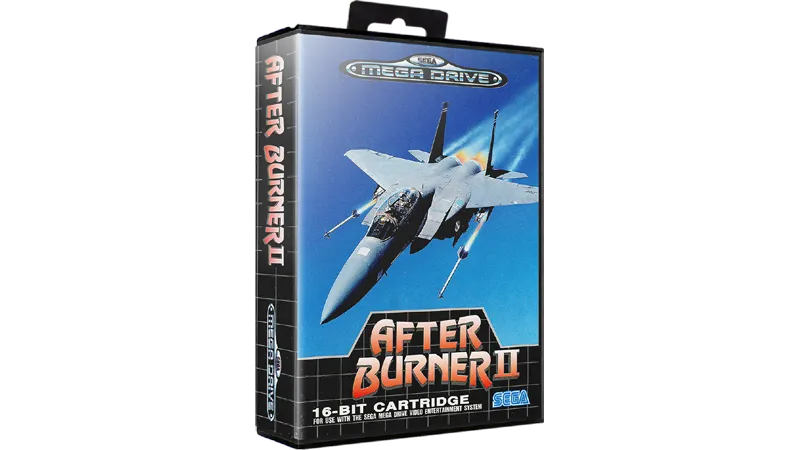


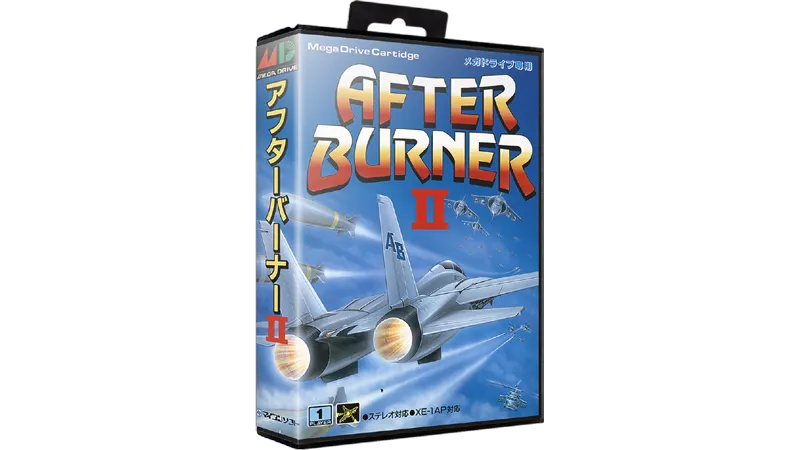

After Burner II on the Mega Drive represents one of Sega’s most ambitious early attempts to bring the high-octane "Super Scaler" arcade experience into the home. Developed by the legendary AM2 team, this port manages to capture the breakneck speed and chaotic dogfighting of the arcade original, despite the console lacking the dedicated scaling hardware found in the arcade's X-Board. Players take control of an F-14 Tomcat, blasting through eighteen stages of intense aerial combat defined by a distinctive "into the screen" perspective that pushed the Motorola 68000 processor to its absolute limits.
Visually, the game is a marvel of technical compromise and clever programming. To simulate the arcade's fluid sprite scaling, the developers utilized pre-rendered rotations and a rapid-fire update loop that keeps the action moving at a blistering pace. While the background flicker and reduced color palette are noticeable compared to the arcade cabinet, the sheer sense of momentum remains intact. This is complemented perfectly by Hiroshi Kawaguchi’s iconic FM-synth soundtrack, which delivers some of the most memorable tracks in the Sega library, successfully translating the "rock-and-roll" energy of the cockpit experience to the Mega Drive's sound chip.
Ultimately, After Burner II is a pure adrenaline shot that prioritizes twitch reflexes over deep strategy. The controls are incredibly responsive, especially when paired with a specialized flight stick, though the standard three-button pad holds up surprisingly well for executing those essential 360-degree barrel rolls. While it may lack the longevity of a sprawling RPG, its value lies in its status as a "pick up and play" masterpiece that showcases Sega’s "arcade-at-home" philosophy. It remains a foundational title for the system, proving that with enough technical wizardry, even the most demanding arcade giants could find a home on 16-bit hardware.